


Lucknow Leads India in Rooftop Solar 87,000 Homes Already Running on Sunshine
24/04/2026
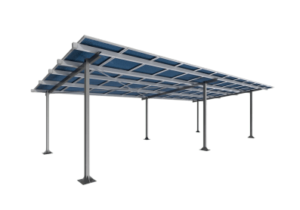
Solar Carport Mounting Systems: The Top PV Racking Trend Reshaping 2026
27/04/2026
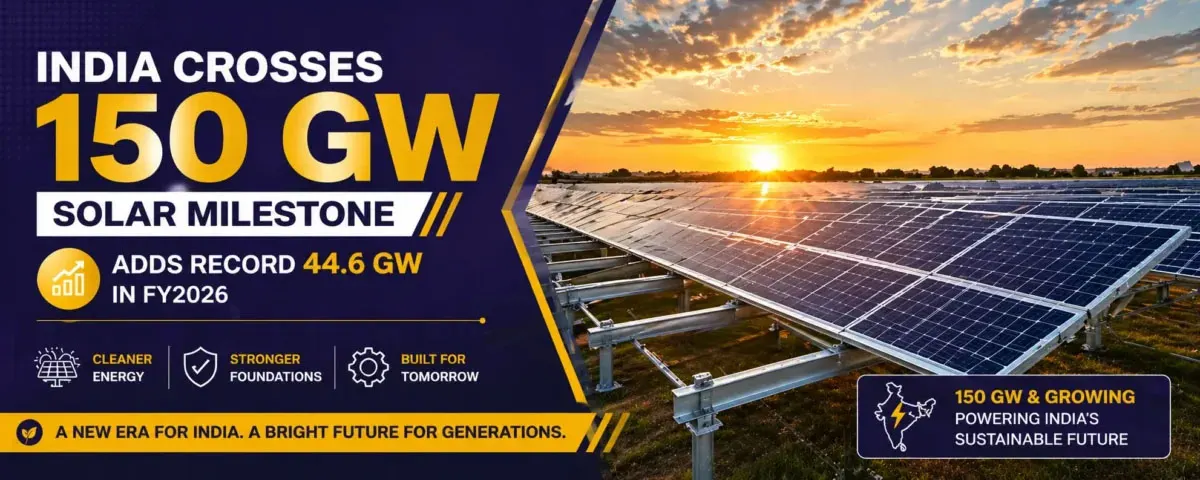
India Crosses Historic 150 GW Solar Milestone — Adds Record 44.6 GW in FY2026
Something remarkable happened in India's energy story this year. Quietly, then all at once — the way big things usually do — the country crossed a number that seemed almost unreachable just a few years ago: 150 gigawatts of installed solar capacity. And it didn't inch past that mark; it sprinted, adding a jaw-dropping 44.6 GW in a single financial year.
Let that sink in for a moment. In FY2026 alone, India installed more solar power than most countries have built in their entire history. This isn't just a national milestone — it's a global statement that India is serious about its clean energy future, and it's moving faster than almost anyone predicted.
How Did We Get Here?
India's solar journey didn't happen overnight. It was years of policy scaffolding, regulatory reforms, falling panel prices, and — crucially — a maturing ecosystem of developers, financiers, and solar mounting companies that could handle projects at scale.
Back in 2015, India set an ambitious 100 GW solar target for 2022. The country missed that deadline, but the groundwork laid during those years proved invaluable. Supply chains were built. Domestic manufacturing got a boost through the Production Linked Incentive (PLI) scheme. Grid infrastructure was upgraded in key states. And solar tariffs kept falling, making utility-scale projects commercially attractive without subsidies.
By 2023–24, the momentum had become self-sustaining. Large-scale parks in Rajasthan, Gujarat, and Andhra Pradesh were being commissioned faster than ever. Rooftop solar installations picked up speed as net metering policies improved. And the government's PM Surya Ghar scheme brought solar rooftop mounting systems to millions of households across the country.
The 44.6 GW added in FY2026 is roughly double the annual additions India was achieving just three years ago. Several factors converged to make this possible:
 Key Drivers Behind the FY2026 Record
- Policy Momentum: MNRE's aggressive tendering calendar ensured a steady pipeline of projects. States like Rajasthan, Gujarat, UP, and Karnataka issued record renewable energy tenders.
- Falling Costs: Solar module prices dropped significantly, making even smaller rooftop and agri-solar projects financially viable for end consumers.
- PM Surya Ghar Scheme: This flagship scheme accelerated rooftop solar adoption for 10 million+ homes, creating massive demand for residential solar mounting structures.
- Domestic Manufacturing: India's PLI scheme helped grow local module manufacturing, reducing import dependency and shortening delivery timelines for large projects.
- Better Grid Integration: Investments in grid storage, power evacuation infrastructure, and green energy corridors allowed more solar power to be absorbed reliably.
- Corporate Renewable Demand: India Inc.'s ESG commitments drove a boom in C&I (Commercial & Industrial) solar — a major market for solar panel mounting solutions and rooftop systems.
The Numbers Tell the Story
Here is how India's annual solar additions have grown over the past five years:
| Financial Year | GW Added | Cumulative Total |
|---|---|---|
| FY2022 | ~14 GW | ~60 GW |
| FY2023 | ~18 GW | ~73 GW |
| FY2024 | ~24 GW | ~90 GW |
| FY2025 | ~32 GW | ~108 GW |
| FY2026 | 44.6 GW 🏆 | 150+ GW |
The acceleration is unmistakable. India has essentially doubled its annual installation pace in just two years. If this trajectory continues — and there is every reason to believe it will — the country could realistically reach 250 GW of solar by 2028–29, putting its 500 GW renewable energy target well within reach.
What This Means for Solar Mounting Companies
Here is where it becomes especially relevant for those of us in the solar infrastructure business.
Every single gigawatt of solar power installed requires an engineered, durable, well-designed solar mounting structure. Whether it is a ground-mounted utility-scale park stretching across hundreds of acres in Rajasthan, a commercial rooftop installation in Pune, or a PM Surya Ghar household rooftop system in a Tier-3 town — none of it happens without the right mounting solution underneath.
At 44.6 GW installed in a single year, demand for solar racking systems, module mounting structures, and installation hardware has reached unprecedented levels. For solar mounting companies, this is both an enormous opportunity and a serious responsibility.
Ground-Mount Solar: The Backbone of India's Capacity Addition
The majority of India's installed solar capacity continues to come from utility-scale, ground-mounted solar farms. These projects — often ranging from 100 MW to 1,000+ MW — require precision-engineered ground mount solar panel systems. Factors like soil conditions, wind load zones, seismic requirements, and the choice between fixed-tilt and single-axis tracker structures all determine the structural design.
As India pushes solar development into more challenging geographies — hilly terrain, flood-prone delta regions, waterlogged agricultural land — the engineering demands on solar mounting structure manufacturers are only increasing. Floating solar projects on reservoirs and irrigation canals are also gaining momentum, introducing entirely new structural design challenges.
Rooftop Solar: A Residential Revolution
The PM Surya Ghar scheme has triggered a genuine rooftop solar revolution at the household level. With government subsidies making systems affordable for ordinary families, the volume of residential rooftop installations has grown dramatically.
This segment is particularly interesting for rooftop solar mounting companies because it demands standardised, lightweight, easy-to-install products that non-specialist electricians and local solar installers can work with confidently. Adjustable tilt brackets for different roof pitches, aluminium rail systems, and compatibility across tin-sheet and RCC rooftop types have become essential requirements for any solar mounting company serving this market at scale.
Agrivoltaics and Agri-Solar: The Emerging Frontier
One of the most exciting and underreported developments in India's solar story is the rise of agrivoltaics — combining solar power generation with active agricultural use on the same land.
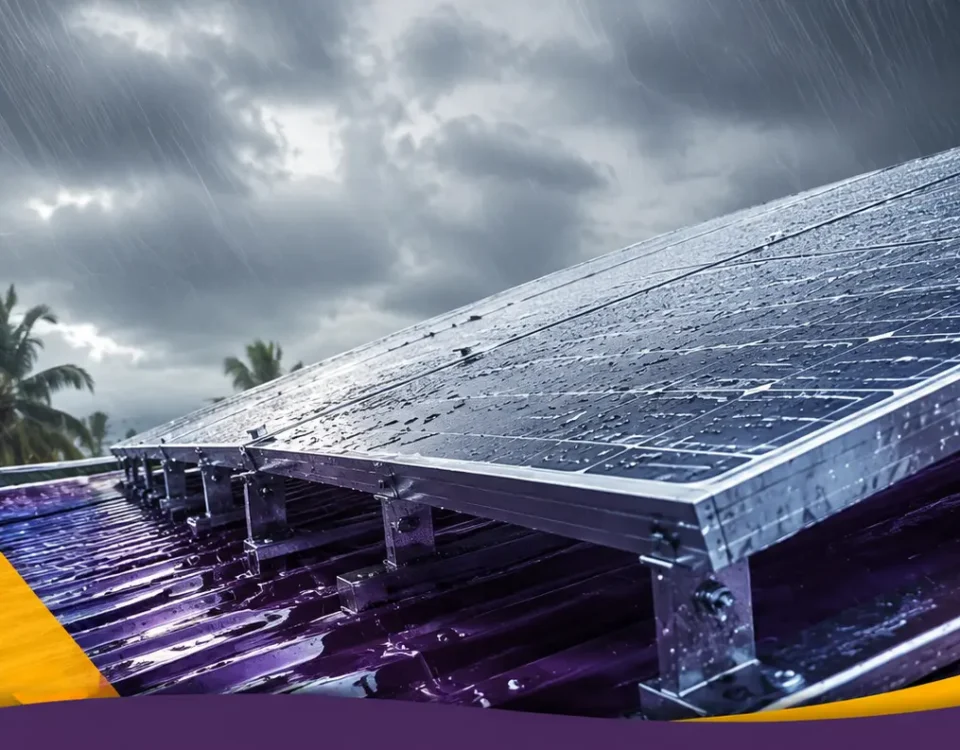
The PM-KUSUM scheme has been a key driver here, helping farmers install solar pumps and earn additional income by selling surplus power back to the grid. Agri-solar projects require elevated solar mounting structures — typically 3 to 4 metres high — that allow crops and farm machinery to operate freely underneath the panels. This is a structurally demanding application that calls for robust engineering, hot-dip galvanisation, and materials that can withstand years of outdoor exposure in humid and monsoon-heavy conditions.
The Solar Mounting Opportunity — In Real Terms
To appreciate the scale of opportunity for solar mounting companies, consider this:
A typical 1 MW ground-mounted solar plant requires approximately 2,500 to 3,000 solar panel mounting structures, depending on module wattage and structural design. At 44.6 GW added in FY2026, that translates to mounting demand for roughly 44,600 MW of new solar capacity — spread across utility-scale, commercial, and residential segments.
Add to that the rising demand for single-axis solar trackers (which increase energy yield by 20–25% compared to fixed-tilt systems and are being adopted in large-scale projects), and it becomes clear that the solar module mounting structure market is undergoing a structural transformation of its own.
FY2027 is expected to push installations even higher. The pipeline for solar mounting companies in India has never been stronger.
Challenges the Industry Cannot Ignore
It would be dishonest to write only a celebration of this milestone without acknowledging the real challenges ahead.
Quality Concerns in a Fast-Scaling Market
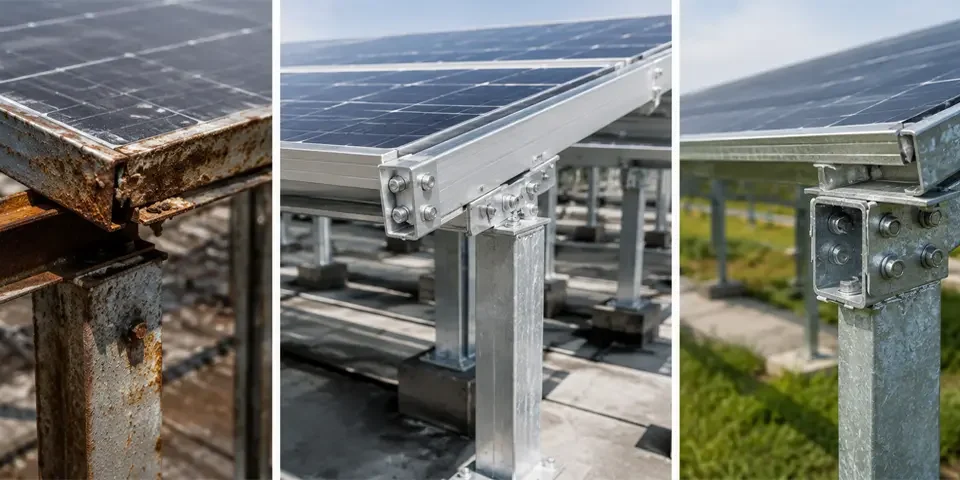
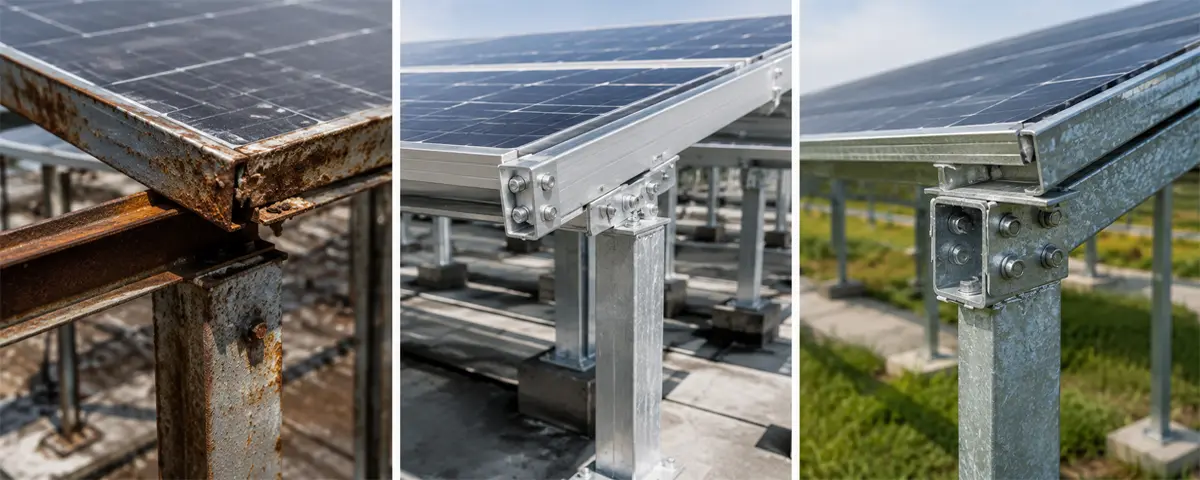
The rapid scale-up has attracted a wave of low-cost, low-quality mounting structure suppliers. Projects using substandard galvanisation, thin steel sections, or under-engineered fastener systems are a genuine risk — especially in high wind-speed coastal zones and cyclone-prone states. A failed mounting structure does not just damage panels; it damages the financial case for the entire project and the reputation of the solar industry.
Quality solar mounting companies must resist the race to the bottom on price and continue investing in engineering rigour, certifications, and quality control.
Skilled Labour Shortages
Installation velocity at this scale requires large numbers of trained, experienced crews. Upskilling solar installation technicians — including those working specifically on solar mounting systems — remains a gap that the industry must address collectively.
Grid Curtailment in High-Solar States
In states with very high solar penetration, daytime generation is increasingly being curtailed because the grid cannot absorb it all. Battery storage integration at scale is the long-term solution, but until storage costs fall further, curtailment will continue to affect project economics.
Land Acquisition Challenges
Large-scale ground-mount projects still face land-related delays in many states. This is pushing some developers toward distributed rooftop and agri-solar models — which is actually good news for solar mounting companies that have diversified product lines.
Raw Material Price Volatility
Steel and aluminium — the primary inputs for solar mounting structures — continue to see price swings that affect project costs and margins. Smart procurement, domestic sourcing, and forward contracts are becoming important tools for mounting companies managing these risks.
Looking Ahead: India's Path to 500 GW
With 150 GW of solar already installed, India needs to add another 200+ GW of solar (plus wind, hydro, and storage) in roughly four years to hit its 500 GW renewable energy target by 2030. That is a relentless pace — but FY2026 has proven it is achievable.
Several large bets are also in play. India's offshore wind sector, barely tapped so far, could add significant capacity in the late 2020s. Green hydrogen projects — which require enormous amounts of renewable power — will create additional demand. And as electric vehicle adoption accelerates, EV charging infrastructure powered by solar will become mainstream, driving further demand for commercial and residential solar mounting solutions.
For solar mounting companies operating in India today, the next five years represent perhaps the single greatest business opportunity in the country's clean energy history. The companies that invest in quality engineering, product innovation, skilled people, and genuine after-sales support will be the ones that earn long-term trust — and long-term contracts.
Our Role in This Story
As a solar mounting company that has been part of India's renewable energy journey, we feel the weight and the excitement of this moment in equal measure.
Every project we support — from a 500 MW ground-mount park in Rajasthan to a 10 kW rooftop system on a shop in Nagpur — is a small thread in the much larger fabric of India's energy transformation. We have seen firsthand how the right solar module mounting structure makes the difference between a solar system that performs reliably for 25 years and one that needs expensive corrective work within five.
Wind load calculations matter. Galvanisation quality matters. Proper torque on fasteners matters. Structural tilt tolerance in monsoon conditions matters. These are not abstract engineering details — they are the difference between a project that delivers returns for its owner and one that quietly becomes a liability.
As India scales toward 200 GW, 300 GW, and eventually 500 GW, the quality of the mounting infrastructure beneath every solar panel will quietly determine whether the country's renewable revolution is built on solid ground — literally.
Frequently Asked Questions
Final Thought
India crossing 150 GW of solar capacity is more than a number on a government dashboard. It is proof of what becomes possible when policy, capital, technology, and execution all move in the same direction at the same time.
It is a signal to investors, developers, and clean energy believers around the world that India is serious, India is capable, and India is accelerating. And for everyone working in the solar value chain — including those of us who build the structures that hold it all together — it is a reminder of exactly why this work matters.
The sun rises every single day. We are just getting better at catching it.