

India’s 81 GW Solar Record April 2026: Why Quality Mounting Infrastructure Is Critical for Grid Stability
02/05/2026
Agrivoltaic Solar Mounting Structures India 2026: Elevated Ground Mount Design for PM-KUSUM 2.0 Projects
15/05/2026
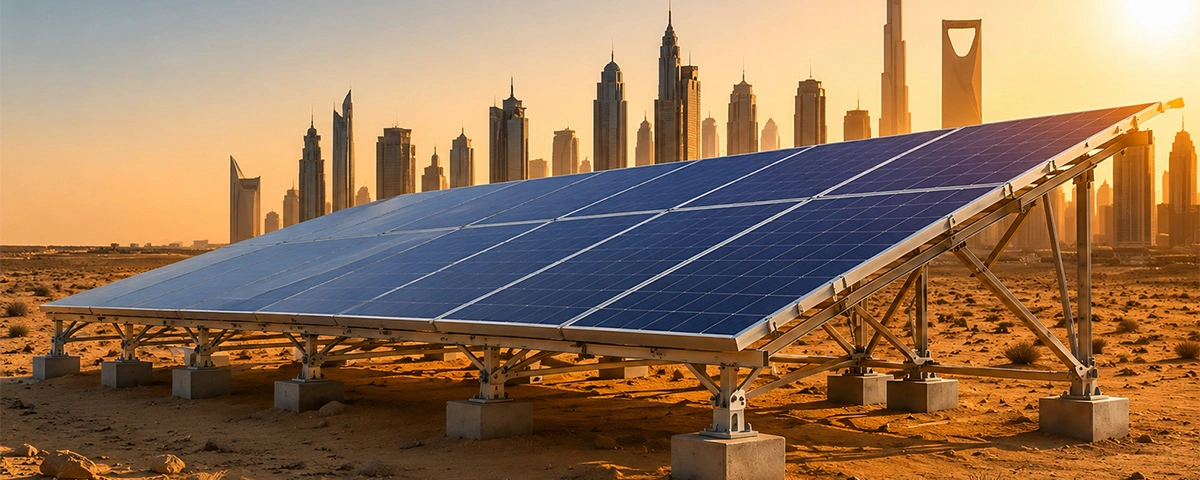
Solar Mounting Systems for UAE, Saudi Arabia & Oman: Desert Heat, Wind Load & Corrosion Resistance Guide
The Gulf region is fast becoming one of the world's most ambitious solar energy markets — and for good reason. With some of the highest solar irradiance levels on Earth, countries like the UAE, Saudi Arabia, and Oman are aggressively expanding their renewable energy portfolios. But here's the catch: deploying solar in the Gulf is not the same as deploying it anywhere else.
The extreme desert environment — scorching temperatures, abrasive sandstorms, salt-laden coastal air, and occasional gale-force winds — places unique demands on every component of a solar installation. Nowhere is this more critical than in the solar mounting system. Choose the wrong racking solution, and you're not just looking at reduced efficiency — you're risking structural failure, voided warranties, and costly replacements.
This guide is built for solar developers, EPC contractors, and energy procurement professionals who want to get it right the first time.
Why the GCC Environment Demands Specialized PV Racking Solutions
Most solar mounting systems are engineered for temperate climates. The GCC is anything but temperate.
In Dubai, Riyadh, and Muscat, ambient temperatures regularly exceed 45°C in summer, and rooftop or ground surface temperatures can climb well above 70°C. That kind of heat causes metal to expand, coatings to degrade, and polymer components to fatigue over time. A PV racking solution that isn't specifically rated for these conditions can fail silently — long before your 25-year performance guarantee runs out.
Add to this the persistent challenge of blowing sand and dust. Fine silica particles act as an abrasive, wearing down protective coatings and creating microscopic entry points for moisture. In coastal areas of Abu Dhabi, Jeddah, and Salalah, salt-spray corrosion compounds the problem further — attacking even high-grade metals if they aren't properly treated.
And then there's the wind. While the Gulf may not experience hurricanes, seasonal shamal winds in the UAE and Saudi Arabia can generate sustained gusts that put serious lateral and uplift stress on fixed and tracking mount structures.
Heat Resistance: What to Look for in Desert Solar Mounting Systems
When evaluating solar mounting systems for UAE, Saudi Arabia & Oman, thermal performance is the starting point. Here's what matters:
Material grade matters enormously. Aluminum alloys — particularly 6005-T5 and 6061-T6 — offer an excellent strength-to-weight ratio and perform reliably at high temperatures without significant creep or deformation. Avoid generic aluminum profiles not tested for GCC thermal cycles.
Anodizing depth and quality. Look for anodized coatings of at least 20 microns on aluminum components. This provides a hard, oxide-based barrier that resists UV degradation, which in the Gulf is among the most intense in the world.
Low thermal mass design. Systems engineered with minimized contact points between the module and the structure reduce heat transfer to panels, which directly improves energy yield during peak summer hours.
Wind Load Engineering for GCC Solar Installations
Wind load compliance is non-negotiable for commercial and utility-scale solar projects in this region. Saudi Arabia's SBC 301 standard and the UAE's EN 1991-1-4 wind action guidelines set the legal minimum — but smart developers engineer beyond the minimum.
For ground-mounted solar racking systems in open desert terrain, wind can approach from any direction and at unpredictable angles. Key considerations include:
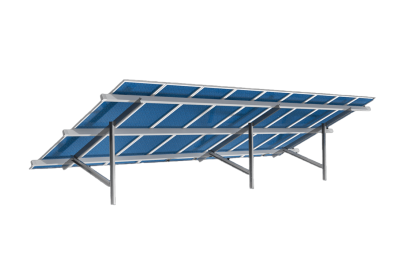
- Aerodynamic tilt angles — systems optimized for 10°–15° tilt reduce wind uplift while maintaining strong irradiance capture across GCC latitudes.
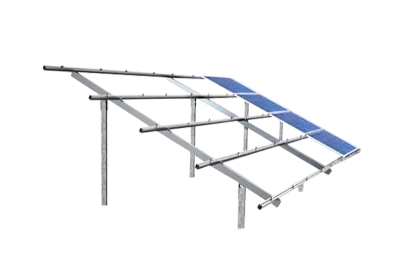
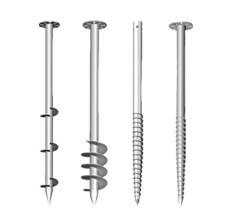
- Ballasted vs. pile-driven foundations — in rocky Omani terrain, ground-anchoring with helical piles or concrete ballasts is preferred over driven steel posts, which can be impractical in hard substrata.
- Dynamic wind tunnel testing — premium racking suppliers now provide wind tunnel certification for their systems in desert terrain simulations, a strong differentiator when tendering for large projects.
For rooftop projects — increasingly common across commercial districts in Dubai, Jeddah, and Muscat — wind uplift on parapets and building edges must be mapped carefully against local building codes before mounting selection is finalized.
Corrosion Resistance: The Silent Killer of Gulf Solar Projects
Corrosion may be the most underestimated threat to long-term solar asset performance in the Gulf. It's slow, invisible in early stages, and devastating by the time it becomes obvious.
The best solar mounting systems for UAE, Saudi Arabia & Oman address corrosion through a layered approach:
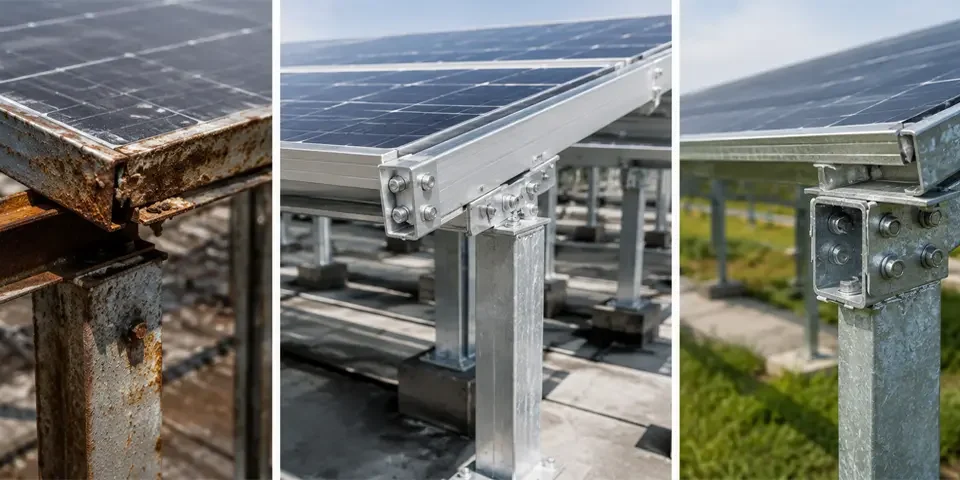
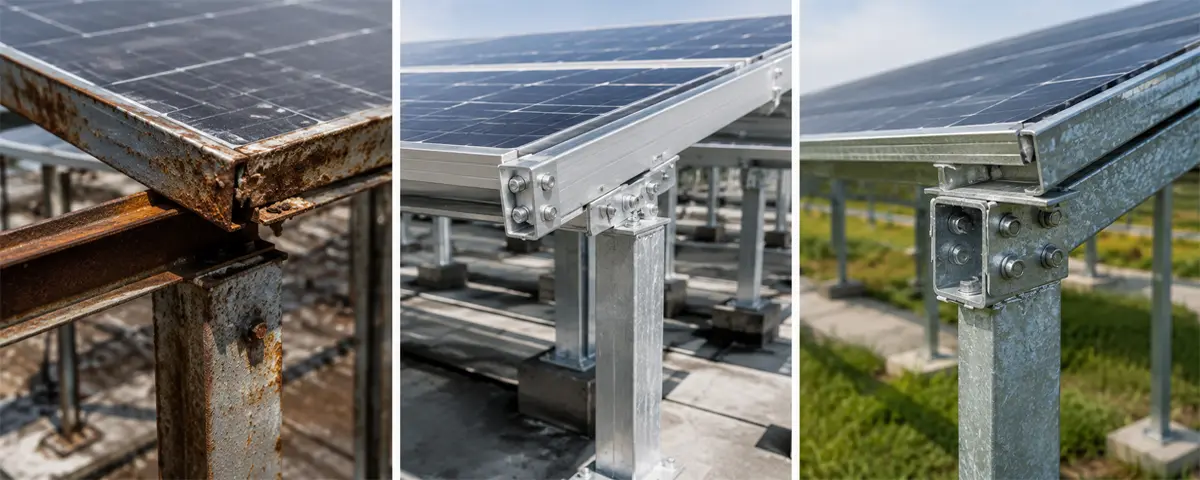
Hot-dip galvanized steel (HDG) is the workhorse for structural steel in aggressive environments. Look for a minimum coating of 85 microns to ASTM A123 or ISO 1461, with sealing at cut edges and drill points.
Marine-grade stainless steel fasteners (316L) are essential in coastal zones. Using 304-grade or carbon steel hardware in proximity to seawater is a common — and expensive — mistake.
Powder-coated finishes add a secondary corrosion barrier on visible components, but only when applied over properly prepared substrate. Adhesion failure in heat cycling is a known issue with inferior preparation methods.
Isolation between dissimilar metals is equally critical. Aluminum-to-steel contact without proper isolation bushings will create galvanic corrosion that degrades both materials within a few years.
Market Trends: GCC Solar Is Scaling Fast
The numbers tell the story clearly. Saudi Arabia's Vision 2030 targets 50% renewable energy by 2030, with solar at the center of that ambition. The UAE has committed to 44% clean energy by the same year, backed by projects like the 2.1 GW Mohammed bin Rashid Al Maktoum Solar Park — one of the largest single-site solar installations in the world. Oman is targeting 30% renewable energy by 2030, with utility-scale solar projects accelerating across the Dhofar and Masirah regions.
This scale of deployment means that PV racking solutions are increasingly being procured at project-level volumes of 50 MW and above. Developers and EPCs are now demanding localized supply chains, faster lead times, and suppliers with proven in-country installation support.
A notable trend is the rise of single-axis tracking systems across utility-scale GCC projects. Trackers can increase energy yield by 20–30% compared to fixed-tilt systems — a meaningful gain when projects are measured across hundreds of megawatts. However, trackers introduce greater mechanical complexity and require mounting systems specifically engineered for sand infiltration resistance and lubrication stability at extreme temperatures.
Choosing the Right Solar Racking Partner for GCC Projects
Beyond the technical specifications, the right solar mounting system supplier for Gulf projects should bring:
- Regional project references — verified installations in UAE, KSA, or Oman with documented post-installation performance data
- Local engineering support — ability to provide stamped structural drawings compliant with local authority requirements
- Flexible logistics — with GCC ports and construction schedules being what they are, buffer stock and flexible delivery windows are not a luxury
- IEC and local certifications — IEC 61215, IEC 61730, and compliance with local SASO (Saudi Arabia), ESMA (UAE), and DCRP (Oman) standards where applicable
Don't underestimate the value of after-sales support either. A racking supplier who disappears after shipping containers arrive is a liability on a long-term asset.
Future Outlook: Where GCC Solar Mounting Technology Is Headed
The next five years will bring meaningful innovation to solar mounting systems specifically engineered for desert markets. Bifacial module optimization is reshaping ground-clearance calculations, as developers seek to maximize rear-side irradiance gains from high-albedo desert sand. Floating solar — already piloted in Oman's coastal reservoirs — will drive demand for corrosion-resistant marine mounting platforms.
AI-assisted structural monitoring is also emerging, with smart mounting systems capable of detecting tilt anomalies, fastener stress, and corrosion onset before they become performance or safety issues. For long-life utility assets in remote GCC locations, this kind of predictive maintenance capability will become a standard expectation.
Conclusion
The Gulf solar boom is real, and the infrastructure behind it needs to be built to last in one of the world's most demanding environments. Selecting the right solar mounting systems for UAE, Saudi Arabia & Oman means going beyond the price-per-watt comparison. It means understanding how desert heat degrades materials, how shamal winds stress structures, and how salt air silently corrodes hardware that looks fine on the surface.
For developers and EPCs working in this market, the mounting system is not a commodity — it's the foundation of your energy asset's long-term performance. Choose accordingly, and your project will deliver reliable returns for decades. Cut corners here, and the desert will find out.