

Agrivoltaic Solar Mounting Structures India 2026: Elevated Ground Mount Design for PM-KUSUM 2.0 Projects
15/05/2026
Single Axis Solar Tracker vs Fixed Tilt Mounting: Real ROI Comparison for India & GCC Utility Projects 2026
21/05/2026
Introduction: Why Structure Design Can Make or Break Your Solar Project
India is racing toward its 500 GW renewable energy target by 2030 — and ground-mounted solar is leading the charge. From sprawling 100 MW utility farms in Rajasthan to community-scale 1 MW installations in Maharashtra, the demand for technically sound, cost-efficient solar infrastructure has never been higher.
Yet here's the thing most developers learn the hard way: a solar project is only as good as the structure holding it up.
Ground mount solar structure design is the backbone of any large-scale PV project. Get it right, and you're looking at 25+ years of reliable generation with minimal maintenance. Get it wrong, and you're dealing with panel misalignment, corrosion failures, structural collapse under wind load — and expensive rework that eats into your IRR.
This guide is built for EPC contractors, project developers, and solar engineers working on projects ranging from 1 MW to 100 MW across India. We'll break down the engineering essentials, material choices, PV racking solutions, and 2026 market trends you need to know.
What Is a Ground Mount Solar Structure?
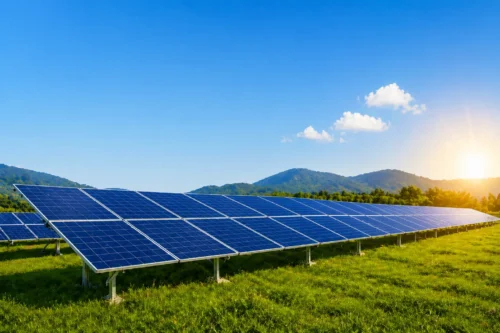
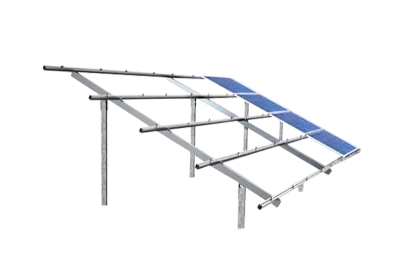
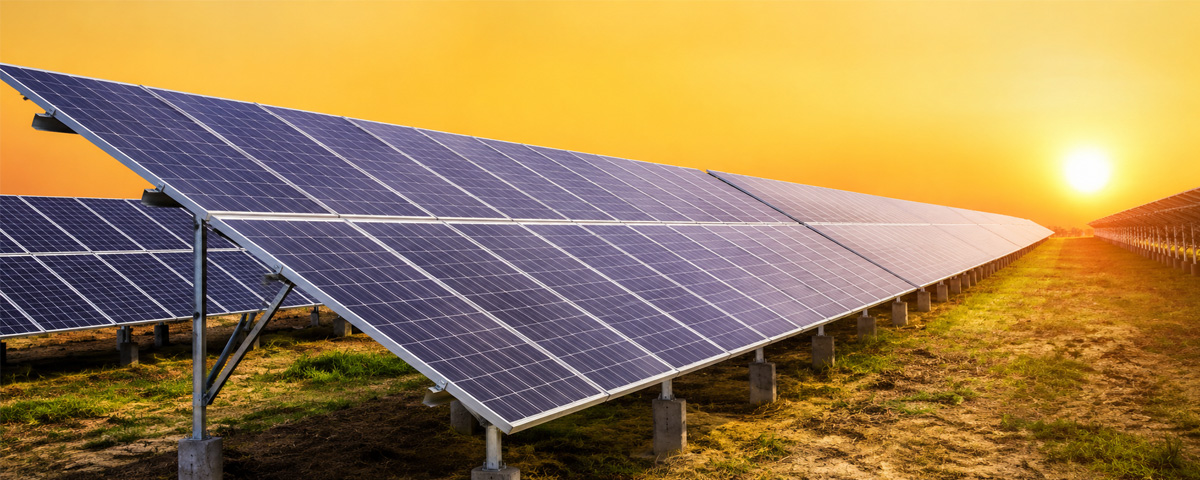
A ground mount solar structure is a fixed or tracking framework — typically made from galvanized steel or aluminum — that holds PV modules at an optimal tilt angle above the ground. Unlike rooftop systems, ground-mounted installations offer greater flexibility in orientation, easier maintenance access, and the ability to scale to very large capacities.
For utility-scale projects in India, the most common configurations are:
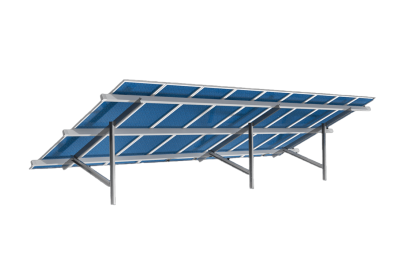
- Fixed Tilt Structures – modules set at a predetermined angle (typically 10°–25° depending on latitude)
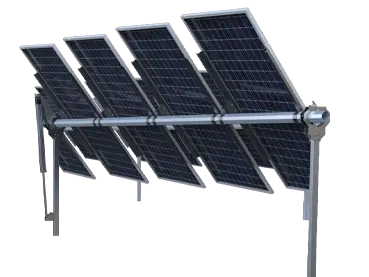
- Single-Axis Trackers (SAT) – modules rotate on a north–south axis to follow the sun
- Dual-Axis Trackers – maximum energy capture, higher cost; used in niche applications
For most 1 MW to 100 MW projects across India in 2026, single-axis trackers are becoming the default choice for developers chasing better CUF (Capacity Utilization Factor) without overcomplicating the BOM.
Key Engineering Parameters You Can't Ignore
1. Wind and Snow Load Analysis
Every ground mount solar structure design must be engineered to withstand site-specific wind speeds as per IS 875 Part 3 (Wind Loads on Structures). Rajasthan and Gujarat projects face basic wind speeds of 39–47 m/s. Coastal sites in Tamil Nadu or Andhra Pradesh can push even higher.
Finite Element Analysis (FEA) is now standard practice among serious EPC players — don't work with a structural vendor who's still relying on rule-of-thumb calculations alone.
2. Soil Investigation and Foundation Design
Ground conditions vary dramatically across India's solar belt. Black cotton soil in Vidarbha, sandy loam in Rajasthan, and hard laterite in Karnataka each demand different foundation approaches:
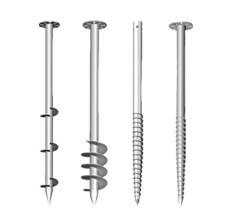
- Driven Pile Foundations – fastest installation, ideal for loose to medium-density soils
- Screw Pile / Helical Piers – excellent for rocky or variable terrain
- Concrete Stub / Isolated Footings – used where pile driving is infeasible
A proper soil investigation (SPT/CPT tests) before finalizing the PV racking solution saves enormous cost and rework downstream.
3. Module Tilt and Inter-Row Spacing
Tilt angle optimization is latitude-dependent. For most of India (18°N–28°N), a fixed tilt of 22°–26° maximizes annual yield. But the real engineering challenge is inter-row spacing — the gap between module rows that prevents shading.
Use the GCR (Ground Coverage Ratio) as your design lever. A GCR of 0.35–0.45 is typical for fixed tilt in India, balancing land utilization against shading losses. For single-axis tracker systems, backtracking algorithms further reduce inter-row shading losses at low sun angles.
4. Material Specifications and Corrosion Protection
For long-term performance in India's diverse climatic zones:
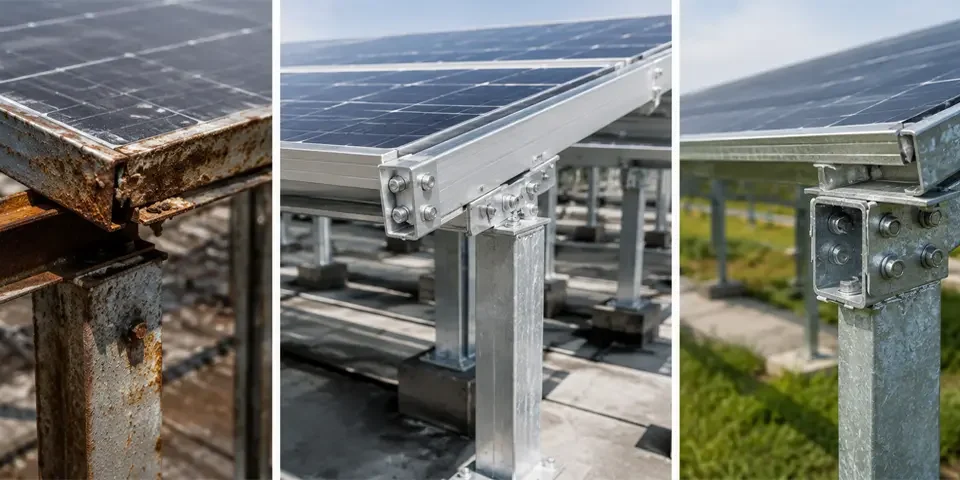
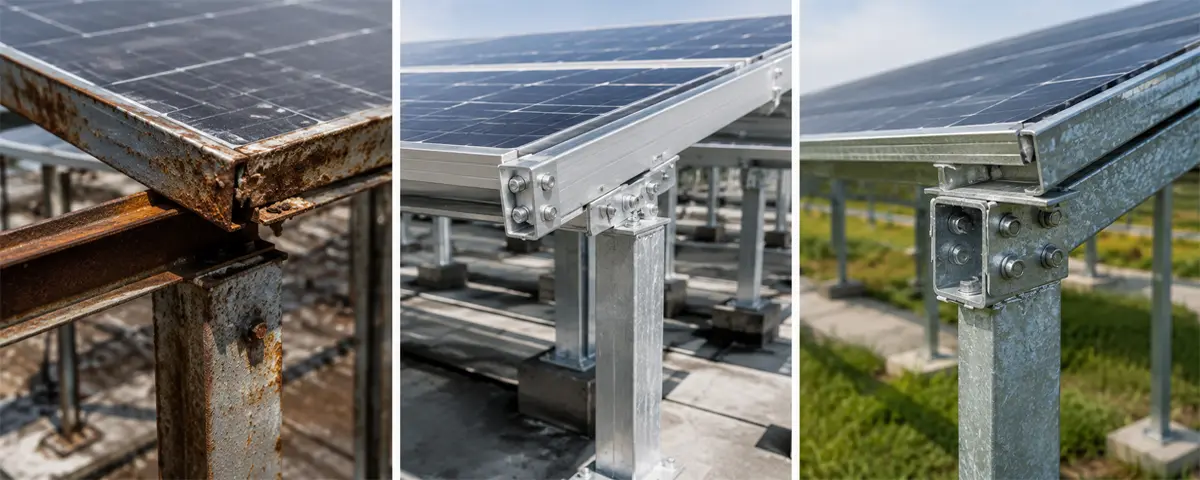
- Hot-Dip Galvanized Steel (HDG) with minimum 85 microns zinc coating (as per IS 4759) is the industry standard for purlin and rafter sections
- Pre-Galvanized Steel is acceptable for low-humidity inland sites but avoid it in coastal zones within 5 km of the sea
- Aluminum Alloy (6005-T5 / 6061-T6) is gaining traction for module rails in corrosive environments despite higher upfront cost
The choice of material directly impacts your 25-year O&M cost — don't let procurement teams cut corners here.
PV Racking Solutions for Large-Scale Projects in India
The Indian PV racking market has matured significantly. In 2026, the leading structural solutions used on 1 MW to 100 MW projects include:
- Horizontal Single-Axis Trackers (HSAT) from suppliers like Nextracker, Array Technologies, and domestic players like Suntrac and Arctech Solar — now offering backtracking and terrain-following capabilities suited to undulating Indian landscapes
- Fixed Tilt Purlin Systems — simpler, lower CAPEX, dominant in projects where land cost is not a constraint
- Bifacial-Optimized Racking — elevated structures (clearance height >1 m) designed to maximize rear-side energy gain from bifacial modules, now the norm in most SECI and state DISCOM tenders
When evaluating a PV racking solution for your project, assess: supply chain reliability, local fabrication capacity, load test certifications, and after-sales structural warranty terms.
Design Process: From Concept to Drawing Package
Here's a simplified breakdown of the structural engineering workflow for a typical 10–50 MW ground mount project:
- Site Survey & Topographic Data – LiDAR or drone-based survey for accurate elevation mapping
- Solar Resource Assessment – TMY data from Meteonorm or NASA POWER
- Layout Optimization – Using PVsyst or PlantPredict to finalize row spacing, tilt, and tracker parameters
- Structural Load Calculations – Wind, dead, live, and seismic loads per IS codes
- Foundation Design – Based on soil report; pile pull-out and push-in capacity verification
- 3D Modeling & Detailing – Tekla Structures or STAAD.Pro for structural drawings
- Fabrication & QC – Third-party inspection at fabrication stage
- Installation & As-Built Documentation – Critical for O&M handover
This process, when followed rigorously, dramatically reduces on-site rework and commissioning delays.
Market Trends Shaping Ground Mount Solar in India (2026)
Tracker penetration is accelerating. Single-axis trackers now feature in over 60% of new utility-scale tenders above 50 MW, driven by falling tracker costs and improved energy yield data from operational projects.
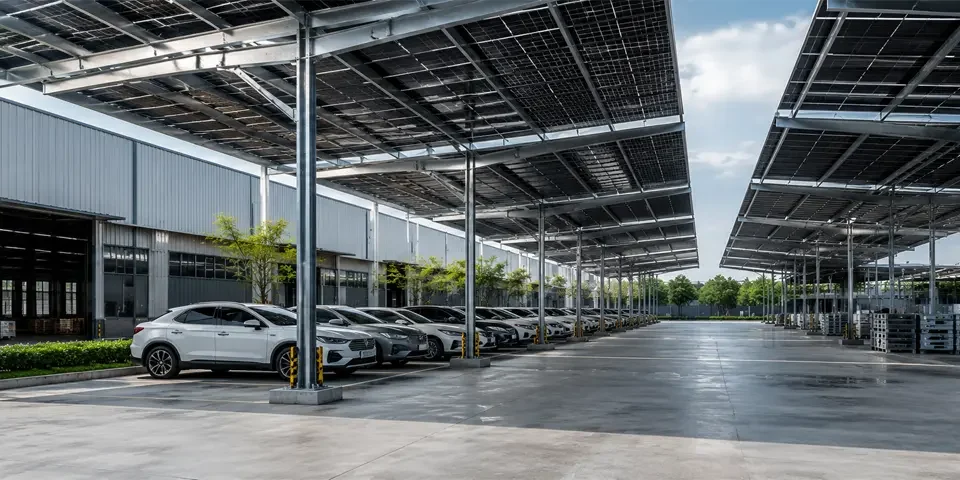
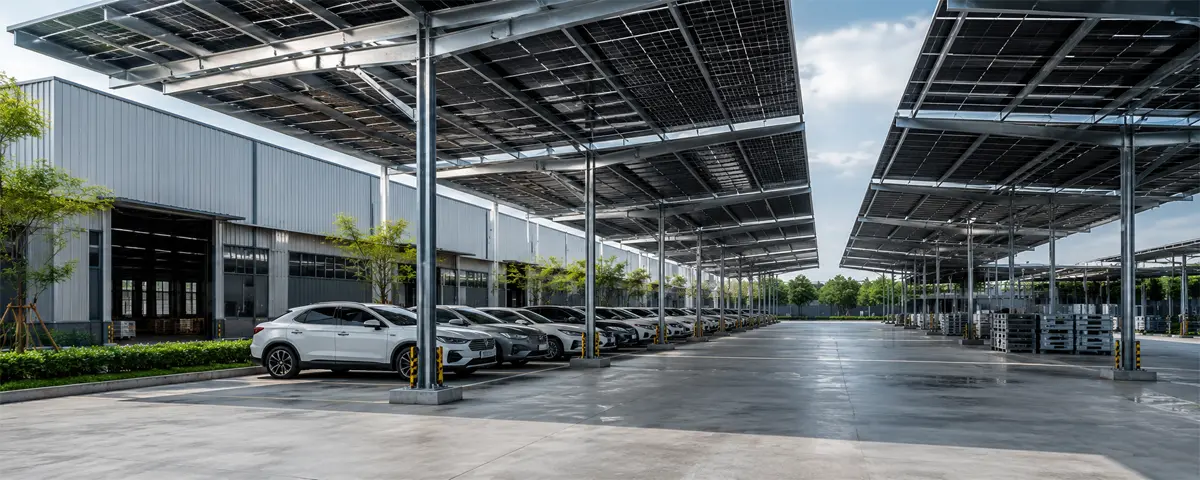
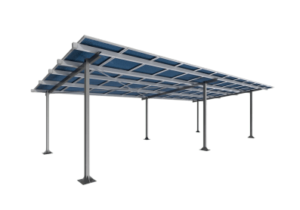
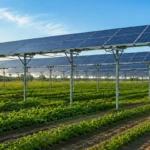
Agrivoltaic installations are emerging. Dual-use land for solar and agriculture — particularly in states like Maharashtra, Telangana, and Karnataka — is gaining policy support. This is pushing structural innovation toward elevated, wider-span designs.
Domestically manufactured structures are preferred. ALMM (Approved List of Models and Manufacturers) for solar modules has set the tone — similar localization pressure is building on the structural side. Projects under KUSUM and PM-SURYAGHAR schemes are increasingly requiring Made-in-India structural components.
Digital twin and drone inspection for structural health monitoring of large parks is moving from pilot to mainstream. Developers with 200+ MW operational portfolios are already onboarding IoT-enabled structural monitoring.
Common Design Mistakes to Avoid
- Underestimating wind load in funneling terrain (valleys, between hillocks)
- Using identical foundation designs across variable soil zones within the same project
- Not accounting for module degradation and changing weight loads over 25 years
- Ignoring thermal expansion gaps in long purlin runs
- Choosing the cheapest PV racking solution without validating load certifications
These errors are correctable on paper. On-site, they cost time, money, and in worst cases — project viability.
Future Outlook: What's Coming for Ground Mount Solar Design
India is targeting 300 GW of solar by 2030. That means millions of tons of structural steel and aluminum will be installed across the country in the next five years. The engineering community will need to evolve fast.
Expect to see greater adoption of AI-assisted layout optimization, BIM-integrated structural design workflows, and performance-linked structural warranties becoming standard in large EPC contracts. Bifacial + tracker combinations will dominate new project designs, while agrivoltaic and floating solar will demand entirely new structural paradigms.
For developers and EPCs who invest now in building strong structural engineering capability — whether in-house or through partnerships — the competitive advantage in winning and executing large tenders will be substantial.
Conclusion: Build on a Strong Foundation — Literally
Ground mount solar structure design isn't a procurement checkbox. It's a 25-year engineering decision that affects every watt your project generates and every rupee your investors expect in return.
Whether you're sizing a 1 MW rural feeder project or engineering a 100 MW utility farm for SECI, the principles remain the same: rigorous site assessment, code-compliant structural design, the right PV racking solution for your terrain, and an eye on long-term durability over short-term cost savings.
India's solar ambition is immense. The projects that will meet that ambition are the ones built on solid ground — structurally and technically.