


Ground Mount Solar Structure Design: Complete Technical Guide for 1 MW to 100 MW Projects India 2026
18/05/2026
Saudi Arabia NREP Solar Projects 2026: Mounting Structure Specs, Local Content Rules & Procurement Guide
21/05/2026

Introduction: The Mounting Decision That Makes or Breaks Your Project Economics
In utility-scale solar development, the racking system you choose isn't just a structural decision — it's a financial one. Whether you're developing a 50 MW project in Rajasthan or a 200 MW plant in Saudi Arabia, the choice between a single axis solar tracker and a fixed tilt mounting system will shape your levelized cost of energy (LCOE), your IRR, and your 25-year revenue curve.
Both technologies have matured significantly. Fixed tilt has become leaner and cheaper. Single axis trackers have become smarter and more reliable. But the real question in 2026 is: which one actually delivers better ROI for your specific site, grid tariff, and capital structure?
This article cuts through the noise with a grounded, numbers-based comparison — built for developers, EPCs, and asset managers working across India and the Gulf Cooperation Council (GCC) markets.
What's Changed in 2026: Market Context You Can't Ignore
The solar mounting systems landscape has shifted meaningfully over the past two years.
In India, the Ministry of New and Renewable Energy's aggressive 500 GW target by 2030 is translating into fierce tariff competition. Every rupee of capex matters. Meanwhile, the GCC — led by Saudi Arabia's NEOM and ACWA Power mega-projects, UAE's clean energy mandates, and Qatar's post-World Cup infrastructure pivot — is scaling utility solar at a pace that demands rigorous technology benchmarking.
Two key trends are reshaping the tracker vs fixed tilt equation in both markets:
- Tracker prices have dropped 18–22% since 2022, narrowing the capex gap with fixed tilt systems considerably.
- Bifacial module adoption has crossed 85% penetration in utility projects globally, and bifacial gain is significantly higher on trackers than fixed tilt — a factor that now materially impacts the ROI calculus.
Fixed Tilt Mounting: Where It Still Wins
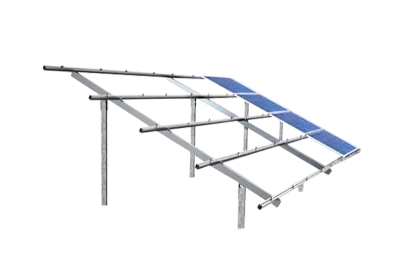
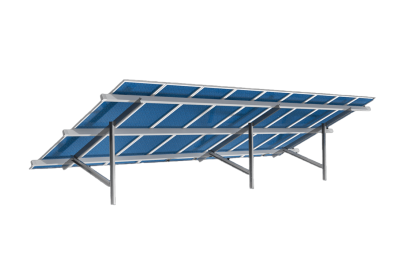
Fixed tilt PV racking solutions remain the default choice for many projects, and for good reason. The economics are straightforward: lower upfront cost, minimal moving parts, virtually zero O&M complexity, and bankability that most lenders are entirely comfortable with.
Typical fixed tilt capex in India: USD 0.025–0.035/Wp (structure only) Typical fixed tilt capex in GCC: USD 0.028–0.040/Wp
For sites with moderate irradiance (GHI below 1,900 kWh/m²/year), constrained budgets, or complex terrain that makes tracker installation impractical, fixed tilt is often the smarter call. It also performs better in high-wind-load environments without the mechanical complexity that trackers bring.
The standard tilt angle in India ranges from 20°–26° (latitude-optimized), while GCC projects typically run at 22°–28°. At these angles, fixed tilt systems capture a solid portion of peak irradiance — just not the shoulder hours that trackers exploit.
Single Axis Solar Tracker: The Performance Case
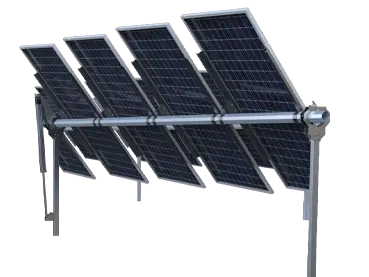
A single axis solar tracker rotates PV panels along a horizontal north-south axis, following the sun from east to west throughout the day. The result: energy yield improvements of 15–25% over fixed tilt, depending on location and season.
In high-irradiance markets like Rajasthan (GHI ~2,200 kWh/m²/year) or Riyadh (GHI ~2,400 kWh/m²/year), that yield premium translates into real, bankable revenue.
Tracker capex in India (2026): USD 0.050–0.065/Wp Tracker capex in GCC (2026): USD 0.055–0.070/Wp
Yes, the upfront cost is higher — typically 60–80% more than fixed tilt on a per-watt basis. But the LCOE math often flips the picture entirely.
Why? Because tracker-generated energy is worth the same per kWh as fixed tilt energy. If you're generating 20% more electricity from the same land area and the same interconnection capacity, your fixed costs (land, grid connection, O&M base, financing) are amortized over a larger energy output. That's the tracker ROI engine.
Real ROI Comparison: India vs GCC Utility Projects
Let's put some real numbers on this. The table below reflects typical 100 MW utility project assumptions for 2026, using current market pricing and irradiance data.
| Parameter | Fixed Tilt (India) | Single Axis Tracker (India) | Fixed Tilt (GCC) | Single Axis Tracker (GCC) |
|---|---|---|---|---|
| Capex (structure only, $/Wp) | 0.030 | 0.058 | 0.034 | 0.062 |
| Estimated P50 yield (kWh/kWp) | 1,680 | 2,010 | 1,920 | 2,300 |
| Yield improvement vs. fixed | — | +19.6% | — | +19.8% |
| LCOE (₹ or AED, relative) | Baseline | –8 to –12% lower | Baseline | –9 to –14% lower |
| Payback period delta | Baseline | +0.6–1.1 years | Baseline | +0.5–1.0 years |
| 25-year revenue advantage | — | +14–18% | — | +15–20% |
Key takeaway: In both markets, trackers deliver meaningfully lower LCOE over project lifetime despite higher upfront cost. The payback period gap closes within 3–5 years, after which the tracker project consistently outearns its fixed tilt counterpart.
The Bifacial Factor: A Game-Changer for Tracker Economics
If your project uses bifacial modules — and in 2026, it almost certainly does — trackers become even more compelling. Bifacial panels generate power from both front and rear surfaces. The rear side captures reflected irradiance (albedo) from the ground beneath the array.
On a single axis tracker, as the panel rotates through the day, the rear surface has a wider, more consistent view of the ground plane. Studies from NREL and independent EPCs in India have shown bifacial gain of 6–12% on trackers versus 3–6% on fixed tilt under similar albedo conditions.
In desert environments — think Thar Desert in Rajasthan or the sandy surfaces common across Saudi Arabia and UAE — albedo is high, pushing bifacial gain toward the upper end of those ranges. This is an often-underappreciated advantage for tracker-based PV racking solutions in GCC utility projects specifically.
Where Fixed Tilt Still Makes Strategic Sense
Despite the tracker performance edge, fixed tilt mounting isn't going anywhere. Here's when it remains the right choice:
Terrain and logistics constraints. Trackers need relatively flat, homogeneous terrain. If your site has undulating topography, rocky sub-soil, or difficult access for machinery, the cost of site preparation can erode the tracker yield advantage entirely.
Wind-heavy sites. Coastal GCC projects or sites in India's wind-resource zones (Gujarat, Tamil Nadu) may face extreme wind events where tracker mechanical reliability becomes a concern — and where additional engineering for tracker foundations increases cost.
Smaller project scales. For projects under 20 MW, the overhead of tracker maintenance infrastructure (control systems, motors, trained technicians) may not be justified. Fixed tilt wins on simplicity.
Grid curtailment environments. In states where morning and evening energy (when trackers outperform) gets curtailed due to grid constraints, the tracker yield premium shrinks significantly. This is a real consideration in certain Indian states today.
Future Outlook: Where Solar Mounting Systems Are Headed
The tracker vs fixed tilt debate won't end soon, but the trajectory is clear: trackers are winning more ground each year, particularly in large-scale, high-irradiance utility markets.
Several developments are accelerating this shift:
- AI-powered backtracking algorithms are reducing inter-row shading losses on trackers by an additional 1–3%, further improving yield.
- Integrated SCADA and weather forecasting on modern tracker controllers are enabling adaptive angle optimization in real time.
- Hybrid terrain trackers (sloped single axis systems) are unlocking tracker deployment on sites previously considered unsuitable.
- In the GCC, Vision 2030 (Saudi Arabia), UAE Net Zero 2050, and Qatar's National Environment and Climate Change Strategy are all driving massive utility solar pipelines — creating high demand for performance-optimized solar mounting systems.
- In India, the Production Linked Incentive (PLI) scheme for solar manufacturing, combined with Approved List of Models and Manufacturers (ALMM) requirements, is reshaping domestic tracker supply chains and improving cost competitiveness.
By 2028, industry analysts project that single axis trackers will account for over 65% of new utility-scale ground mount installations in both India and the GCC — up from roughly 48% today.
Conclusion: ROI Is Site-Specific, But the Trend Is Clear
There's no universal answer to the single axis solar tracker vs fixed tilt mounting debate — and any consultant or vendor who tells you otherwise isn't being straight with you.
What is clear is this: for most high-irradiance utility projects in India and the GCC, trackers deliver superior long-term economics. Lower LCOE, higher energy yield, better bifacial performance, and increasing cost competitiveness make them the default choice for well-capitalized utility developers.
Fixed tilt mounting remains a strong option for terrain-constrained sites, smaller projects, wind-heavy environments, and scenarios where capex minimization is non-negotiable.
The smartest approach? Run a detailed site-specific financial model that accounts for your actual irradiance data, terrain conditions, grid tariff structure, financing cost, and O&M capacity — before committing to either PV racking solution.
For developers and EPCs navigating the India and GCC solar markets in 2026, getting this decision right is the difference between a project that barely clears its hurdle rate and one that delivers exceptional returns for the next quarter century.