


Single Axis Solar Tracker vs Fixed Tilt Mounting: Real ROI Comparison for India & GCC Utility Projects 2026
21/05/2026
Solar Carport Mounting Systems India 2026: How to Turn Parking Lots into Solar Power Plants — Complete Guide
22/05/2026
Introduction: A New Era for Solar in the Kingdom
Saudi Arabia is no longer just talking about solar energy — it's building it at a scale few countries have attempted. Under Vision 2030, the National Renewable Energy Program (NREP) has become the backbone of the Kingdom's clean energy push, with an ambitious target of 58.7 GW of renewable capacity by 2030. And 2026 is shaping up to be a pivotal year.
For developers, EPCs, and solar industry professionals, that means one thing: the pressure to get procurement right — from PV racking solutions to local content compliance — has never been higher. This guide breaks down what you need to know about solar mounting systems for Saudi Arabia NREP solar projects in 2026, from structural specifications to procurement timelines and Saudization requirements.
Why Mounting Structures Matter More Than You Think
In a utility-scale solar project, the mounting structure is not an afterthought. It's the foundation — literally and financially. In Saudi Arabia's environment, where temperatures regularly exceed 45°C and desert winds carry abrasive particulates, choosing the wrong PV racking solution can mean accelerated corrosion, structural fatigue, and costly downtime.
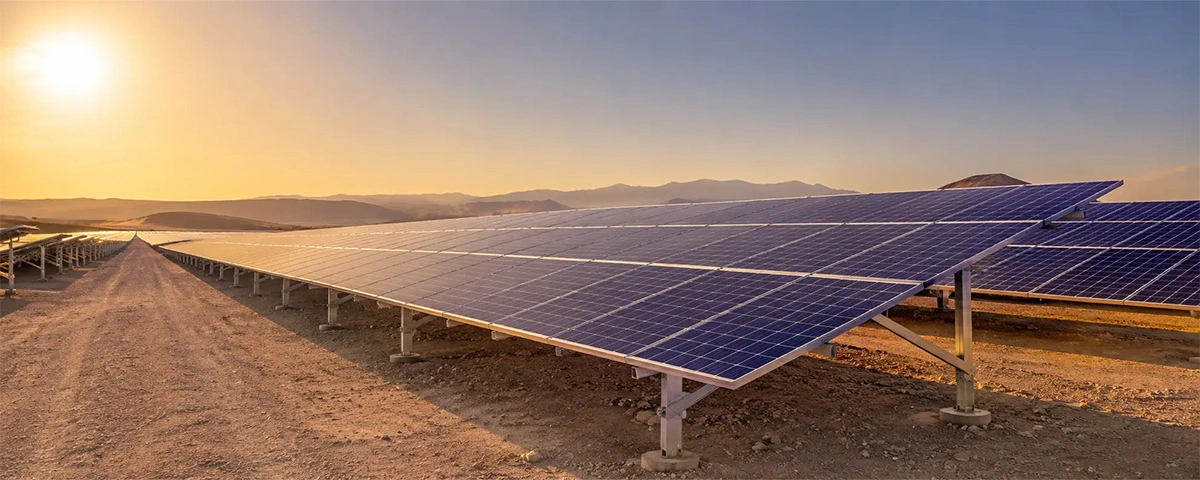
NREP projects are typically large-scale, ground-mounted installations in regions like NEOM, Al-Jouf, Tabuk, and the Empty Quarter corridor. These sites demand mounting systems engineered for:
- High wind and sand load resistance (minimum 200 km/h design wind speed in many zones)
- Thermal expansion tolerance for extreme diurnal temperature swings
- Compatibility with bifacial modules, which are increasingly mandated or preferred in NREP tenders
- Single-axis tracker readiness, now a near-standard expectation in utility-scale bids
Getting the structural spec right from day one isn't just a technical decision — it directly affects your bankability, your O&M cost projections, and your ability to pass REPDO's technical review.
NREP 2026: What's on the Table
The National Renewable Energy Program, managed by REPDO (Renewable Energy Project Development Office) under the Ministry of Energy, is scaling up its tender pipeline significantly in 2026. Several large-scale solar IPP (Independent Power Producer) rounds are expected, ranging from 500 MW to over 2 GW per project.
Key NREP tender characteristics to watch in 2026:
- Fixed-price, long-term PPAs (typically 20–25 years with ACWA Power or Saudi Aramco as off-takers)
- Engineering, Procurement & Construction (EPC) contracts with strict milestone schedules
- Mandatory IKTVA (In-Kingdom Total Value Add) scoring as part of bid evaluation
- Third-party technical review of mounting system design, including wind tunnel modeling for certain sites
If you're bidding on NREP rounds or supplying into the EPC supply chain, understanding the mounting structure requirements is not optional — it's a bid qualifier.
The National Renewable Energy Program, managed by REPDO (Renewable Energy Project Development Office) under the Ministry of Energy, is scaling up its tender pipeline significantly in 2026. Several large-scale solar IPP (Independent Power Producer) rounds are expected, ranging from 500 MW to over 2 GW per project.
Key NREP tender characteristics to watch in 2026:
- Fixed-price, long-term PPAs (typically 20–25 years with ACWA Power or Saudi Aramco as off-takers)
- Engineering, Procurement & Construction (EPC) contracts with strict milestone schedules
- Mandatory IKTVA (In-Kingdom Total Value Add) scoring as part of bid evaluation
- Third-party technical review of mounting system design, including wind tunnel modeling for certain sites
If you're bidding on NREP rounds or supplying into the EPC supply chain, understanding the mounting structure requirements is not optional — it's a bid qualifier.
Solar Mounting Structure Specifications for NREP Projects
Material Standards
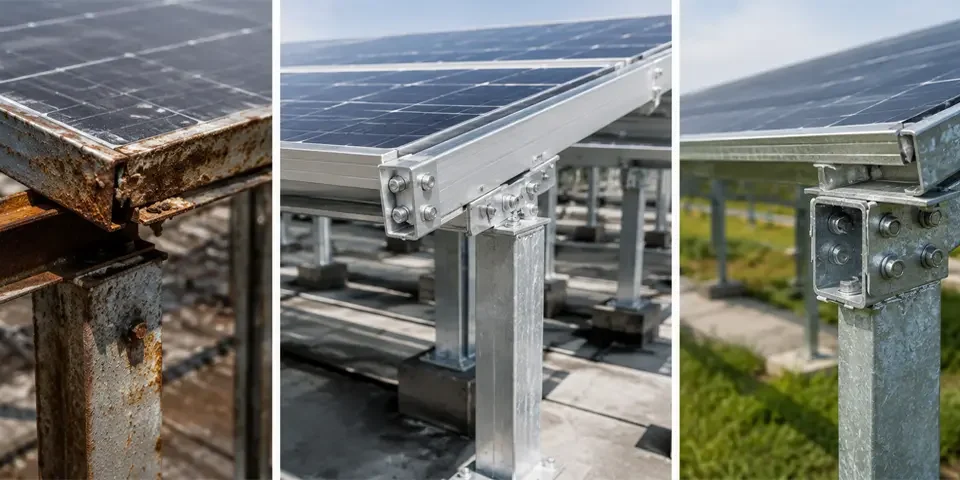
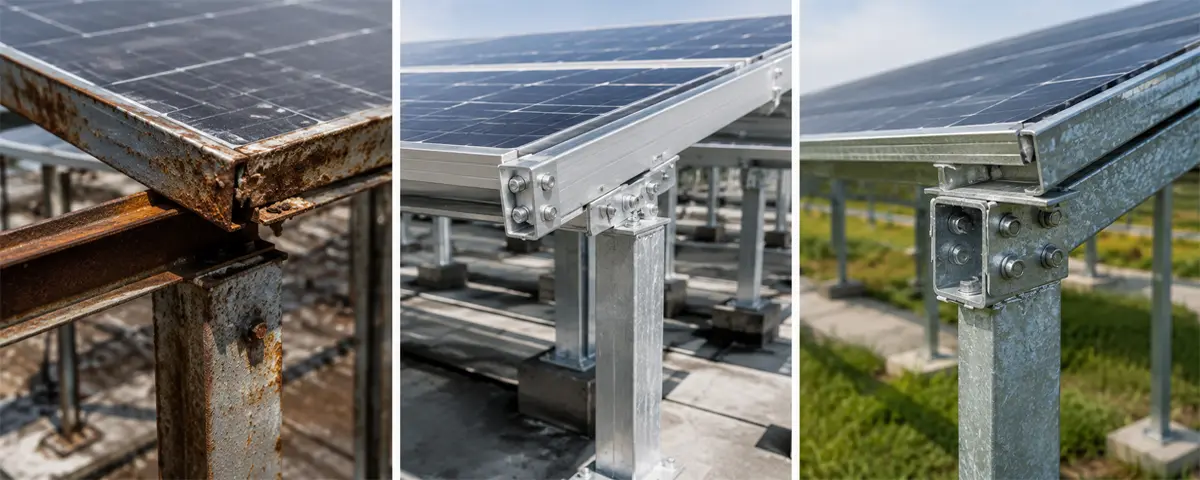
For solar mounting systems in Saudi Arabia NREP projects 2026, the baseline material standard is hot-dip galvanized steel per ASTM A123 or equivalent (zinc coating ≥ 610 g/m²). Some tier-1 EPCs are now specifying dual-coated aluminum extrusions for rail components, particularly in coastal or high-humidity sub-zones.
Structural design must comply with:
- ASCE 7-22 (or equivalent IEC 62817 / EN 1993) for load calculations
- Saudi Building Code (SBC 301) for seismic and wind zoning
- IEC 61215 / IEC 61730 compatibility for module-to-racking interface
Ground-Mounted Fixed-Tilt vs. Single-Axis Trackers
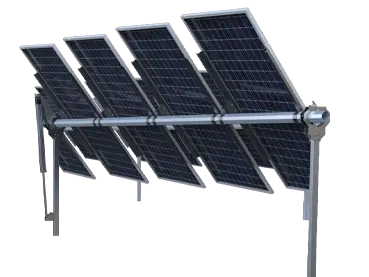
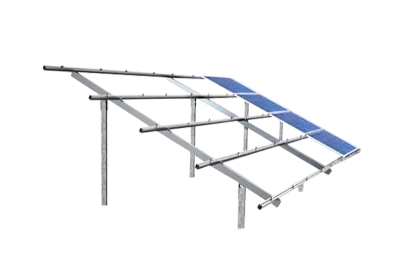
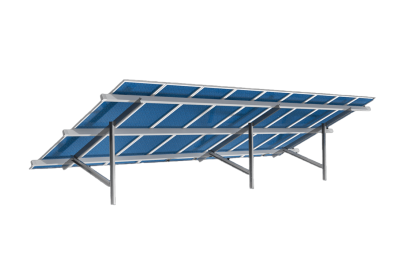
Fixed-tilt systems remain in use for smaller NREP sub-projects and rooftop commercial offshoots, but single-axis horizontal trackers (SAHT) have become the dominant choice for utility-scale NREP projects. The energy yield advantage in Saudi Arabia's flat desert terrain — typically 15–25% more generation versus fixed-tilt — makes the business case clear.
Leading PV racking solution providers active in the Kingdom include NEXTracker, Array Technologies, GameChange Solar, and locally established suppliers certified under IKTVA.
Pile Foundation & Soil Conditions
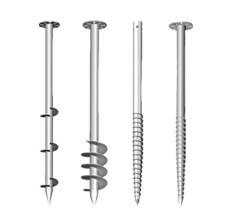
Desert terrain in NREP project zones varies significantly. Sandy, loose soils in the Rub' al Khali require deeper pile penetration (often 2.5m+), while rocky substrates in northern Saudi Arabia may require driven or drilled pier alternatives. Ground-mounted systems must include geotechnical survey data in the technical submission package.
Local Content Rules: IKTVA and Saudization in 2026
This is where many international suppliers and developers stumble. Saudi Arabia's IKTVA (In-Kingdom Total Value Add) program, enforced by the Ministry of Energy and Aramco, requires a measurable percentage of project value to be sourced, manufactured, or executed within the Kingdom.
What IKTVA Means for Mounting Structures
For solar mounting systems in NREP projects, IKTVA compliance typically touches:
- Steel fabrication: Saudi Arabia has domestic steel manufacturing capacity (SABIC, Rajhi Steel). Using locally sourced galvanized steel significantly boosts IKTVA scores.
- Assembly and installation labor: Using Saudi-certified engineering labor (not just subcontracted expatriate crews) is weighted heavily.
- Engineering and design services: In-Kingdom structural engineering sign-off from a Saudi Council of Engineers (SCE)-registered firm is often mandatory.
IKTVA scores are assessed against a 100-point scale, and bids with scores below a threshold (typically 30–40 depending on the package) may be disqualified or scored down in commercial evaluation.
Saudization (Nitaqat) Compliance
Beyond IKTVA, the Nitaqat program sets minimum Saudi national employment quotas for companies operating in the Kingdom. For 2026 NREP projects, EPCs and major suppliers should plan for:
- Minimum 15–20% Saudi national workforce in professional and semi-skilled roles
- HR compliance documentation submitted as part of bid qualification
- Ongoing Nitaqat status verification throughout project execution
Working with a local Saudi partner or JV structure is not just a strategic advantage — in many NREP tender packages, it's a requirement.
Procurement Guide: Navigating the NREP Supply Chain
Step 1: Pre-Qualification and Vendor Registration
Before any purchase order is raised, suppliers of solar mounting systems must complete REPDO's vendor registration process. This includes:
- Technical product certification (IEC, ASTM, or SBC-aligned)
- Financial viability documentation
- Proof of prior utility-scale project references (preferably GCC)
- IKTVA capability statement
Step 2: RFQ and Technical Specification Alignment
Once shortlisted, mounting system suppliers typically receive an RFQ package from the EPC contractor. This document sets out wind and snow load requirements, module compatibility specs, tracker control protocols (if applicable), and pile design parameters.
Key tip: Request the geotechnical report and terrain GIS data early. Mounting structure design is highly site-specific, and suppliers that can submit fast, site-adapted proposals win bid rounds.
Step 3: Factory Audit and QA/QC
REPDO and major EPCs increasingly require factory audits for structural component suppliers, especially for tracker manufacturers. Quality plans must reference ISO 9001 and relevant steel fabrication standards. Third-party inspection (TPI) at the fabrication stage is common for orders above a threshold volume.
Step 4: Logistics and In-Kingdom Delivery
Saudi Arabia's port infrastructure (Jeddah Islamic Port, King Abdulaziz Port Dammam, Jubail) is well-developed, but inland logistics to remote NREP sites require careful planning. Ensure your supply contract addresses:
- Demurrage risk allocation
- Site storage and lay-down area requirements
- Commissioning support obligations for tracker systems
Market Trends Shaping Solar Mounting in Saudi Arabia
Bifacial compatibility is now baseline. Nearly all major NREP utility projects in 2026 specify bifacial modules, which means mounting systems must be optimized for ground clearance and albedo gain — typically 1.0–1.5m row clearance and light-colored gravel or sand beneath arrays.
Tracker software integration is accelerating. Tracker OEMs are now competing on data intelligence, not just hardware. SCADA integration, predictive maintenance alerts, and backtracking algorithms optimized for Saudi irradiance profiles are differentiators.
Domestic manufacturing is growing. Driven by IKTVA incentives, several international tracker and racking brands are establishing local JVs or manufacturing agreements with Saudi firms. This trend will only intensify through 2026 and beyond.
Future Outlook: What's Next for NREP Solar Infrastructure
Saudi Arabia's renewable energy pipeline doesn't stop at 2026. NEOM's solar ambitions alone represent tens of gigawatts of potential deployment. The NREP roadmap through 2030 includes hydrogen-linked solar projects, floating PV pilots on reservoirs, and agrivoltaic feasibility studies in the Al-Ahsa region.
For mounting structure manufacturers and procurement specialists, the opportunity is substantial — but so is the complexity. Companies that invest in IKTVA-aligned manufacturing partnerships, understand REPDO's technical expectations, and can deliver site-specific structural engineering quickly will be the ones capturing NREP contracts through the decade.
Conclusion: Position Early, Qualify Right
Saudi Arabia's NREP solar projects in 2026 represent one of the most significant solar procurement opportunities in the world. But the Kingdom's requirements — from mounting structure specs to IKTVA compliance and procurement timelines — demand preparation, not improvisation.
Whether you're a global racking OEM looking to enter the Saudi market, an EPC sourcing your supply chain, or a developer stress-testing your bid structure, the message is the same: start early, qualify correctly, and localize deliberately.
The solar infrastructure that powers Vision 2030 will be built on strong foundations. Make sure your mounting systems — and your procurement strategy — are part of it.