








Solar Carport Mounting Systems: The Top PV Racking Trend Reshaping 2026
27/04/2026
India’s Solar 2.0 Era: How Agrivoltaics, Bifacial Panels & Elevated Mounting Systems Are Reshaping Agriculture and Energy
28/04/2026
India's Power Grid Just Rewrote the Record Books — And Solar Made It Possible
It was a Saturday afternoon that India's energy planners will talk about for years. As temperatures scorched their way past 44–45°C across north and central India, millions of air conditioners, coolers, and refrigerators switched on simultaneously — and the national grid felt every single one of them.
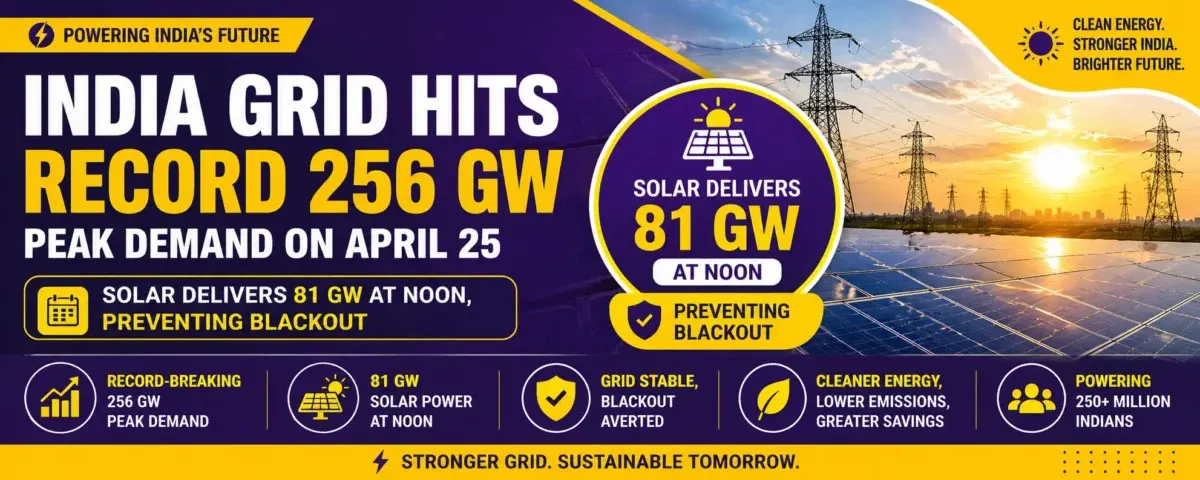
On April 25, 2026, India's power demand surged to an unprecedented 256.11 GW, shattering the previous all-time high of around 250 GW set in May 2024. What's more remarkable, though, isn't just that the record was broken — it's that the lights stayed on. And solar energy deserves a lion's share of the credit.
What Happened on April 25 — The Numbers Tell a Stunning Story
The Grid Controller of India recorded peak demand at 3:38 PM, when 256.11 GW was being drawn from the national grid simultaneously. That's a figure that would have seemed unthinkable even five years ago.
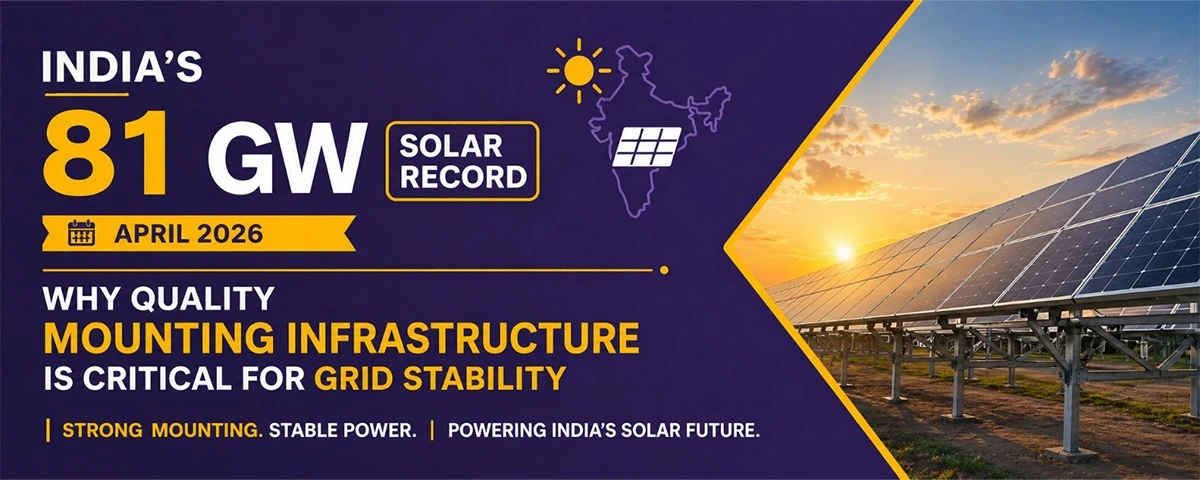
But hours before that evening crunch, something extraordinary happened. At around 12:30 PM, solar generation alone surged to nearly 81 GW — accounting for roughly one-third of India's total electricity generation of 244.6 GW at that point in the day. Even at the afternoon peak, solar was still contributing close to 57 GW, making up about 22% of total generation.
To put this in perspective: in 2023, renewables met just 10.9% of India's peak demand. By 2024, that figure climbed to 15.1%. On April 25, 2026, solar single-handedly carried a third of the country's load at the critical midday hour. That's not incremental progress — that's a transformation.
Why Demand Spiked So Early — and So Sharply
Typically, India's grid demand peaks in June or July, when summer is at its most brutal across northern India. This year, however, the heatwave arrived weeks ahead of schedule, catching planners off guard.
The primary driver was straightforward: heat. With temperatures crossing 40–45°C across multiple states, households and businesses cranked up air conditioners and cooling appliances en masse. Demand had already touched 252 GW on April 24, just a day before the new record — a rapid escalation that signalled extreme stress on the system.
The Grid India weekly forecast for April 20–26 had projected demand around 239.5 GW. The actual figure came in nearly 17 GW higher than that projection — a gap that underscores just how unprecedented this heatwave season has been.
Solar's Finest Hour: How Renewables Prevented a Potential Blackout
This is where the story gets genuinely inspiring.
Not long ago, a demand spike of this magnitude would have been a grid operator's nightmare — scrambling to dispatch every available thermal plant, risking localised outages, and hoping transmission lines could hold. On April 25, solar energy absorbed a massive chunk of that daytime stress.
With 81 GW of solar output at noon, the grid was shielded during the highest-consumption hours of the day. Thermal plants — primarily coal — remained essential for evening and overnight supply, but the daytime burden was dramatically lightened by clean energy. This is precisely the scenario India's energy planners had hoped for when they began aggressively building out solar capacity.
It's also a story of infrastructure maturity. India had barely 4 GW of installed solar capacity in 2015. Today, that number has crossed 150 GW, driven by record additions of nearly 44–45 GW in FY2025–26 alone — one of the fastest solar expansions anywhere in the world. Renewables now account for over 41% of India's total installed power capacity, with solar as the single largest contributor at around 28% of the overall mix.
The Market Trend: India's Solar Boom Is Far From Over
If April 25 proved anything, it's that solar isn't a supplementary source anymore — it's a structural pillar of India's electricity supply.
Several market trends are reinforcing this shift:
Rapid capacity additions: India is on track to add roughly 125 MW of solar capacity every single day through to 2030. At that pace, solar's share of peak supply will only grow.
Battery storage moving centre stage: The infamous "duck curve" — where solar generation collapses in the evening just as household demand spikes — is a well-known challenge. But India is already responding. Government auctions are increasingly dominated by tenders for renewable power paired with energy storage. The Union Budget boosted viability gap funding for battery storage systems tenfold, signalling serious policy intent.
Cooling demand as a structural tailwind: As urbanisation accelerates and climate change drives more frequent, more intense heatwaves, electricity demand for cooling will become a permanent growth driver. This creates a virtuous cycle: the hotter it gets, the more solar energy is available — and the more it's needed.
Global context: Globally, for the first time in over a century, solar and renewables have edged past coal in electricity generation share. In 2025, renewables climbed to nearly 34% of global electricity generation. India's April 25 milestone fits squarely within this worldwide energy transition.
What Lies Ahead — The Real Test Is Coming
Despite the success of April 25, grid managers and policymakers know the hardest months are still ahead. The Power Ministry has projected peak demand could reach 271 GW this summer season as May and June — historically the hottest months — approach.
This means:
- Thermal plants will need to continue operating at full capacity to cover evening and overnight demand.
- Transmission infrastructure upgrades are critical to reduce curtailment risks and allow solar power generated in one region to reach demand centres in another.
- Energy storage deployment needs to accelerate rapidly to shift midday solar surpluses into evening peak hours — the next great frontier for India's grid.
Modelling by energy researchers suggests that battery storage systems can effectively shift daytime solar generation to cover evening needs, allowing solar-plus-storage to meet nearly all demand on most days from January through April. India's policy framework is aligning with this vision, but execution speed will be decisive.
The Bigger Picture: A Grid That's Growing Up
What April 25 demonstrated, beyond the impressive numbers, is a kind of quiet resilience that India's power system hasn't always been known for. A demand figure that would have triggered rolling blackouts a decade ago was absorbed — cleanly, largely without disruption — because a decade of solar investment paid off exactly when it was needed.
This isn't just an energy story. It's an economic and climate story. Every gigawatt of solar that displaces coal-fired generation at peak demand hours reduces carbon emissions, improves air quality in already heat-stressed cities, and demonstrates that the energy transition doesn't have to come at the cost of reliability.
India's grid hit 256 GW on April 25, 2026. Solar helped hold it together. And with 271 GW potentially on the horizon, the solar story in India is only getting more important — and more extraordinary.
Data sourced from the Grid Controller of India, the Ministry of Power, and industry reports as of April 27, 2026.