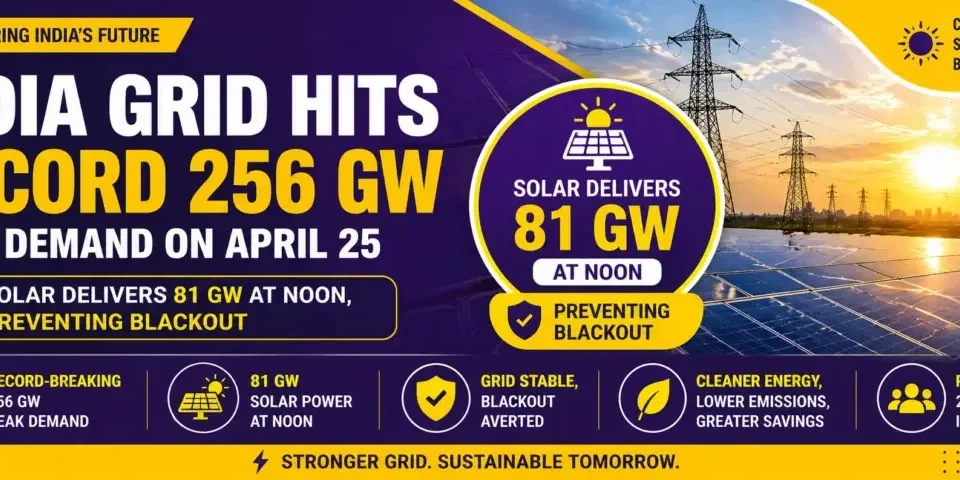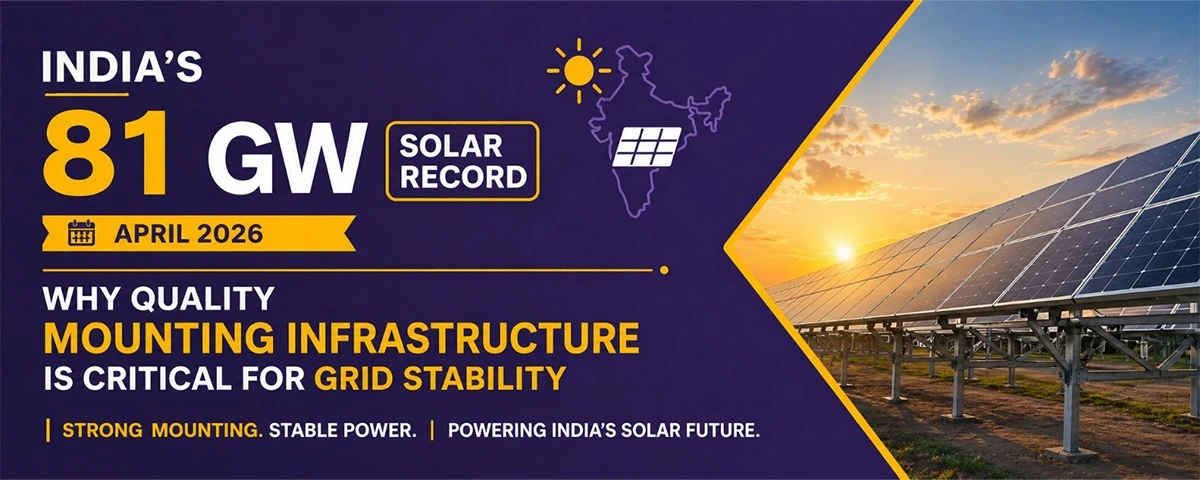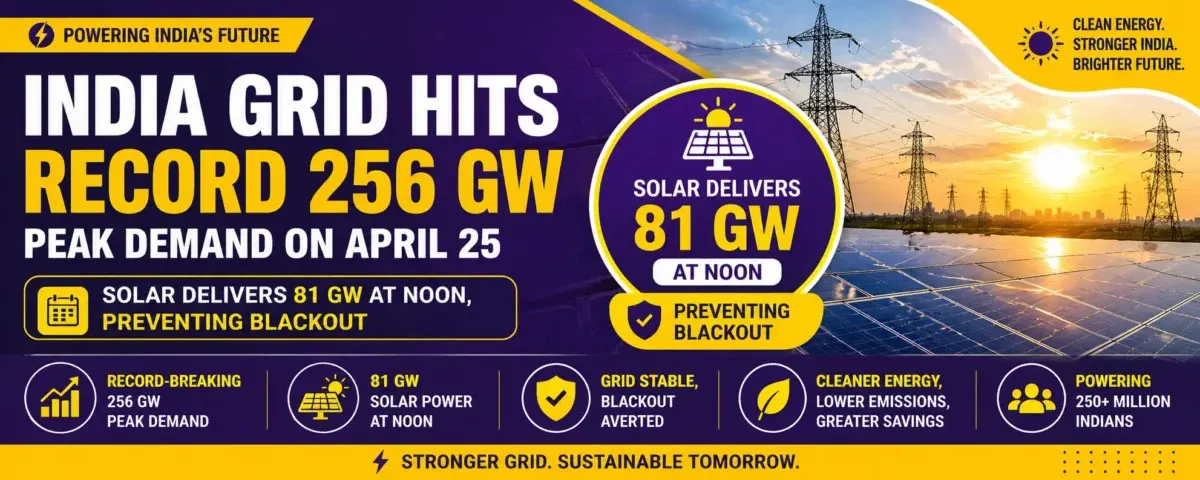



India Grid Hits All-Time Record 256 GW Peak Demand — Solar Power Saves the Day with 81 GW at Noon
28/04/2026
Solar Panel Mounting System Types 2026 Ground Mount Rooftop & Floating Which Is Right for Your Project?
29/04/2026
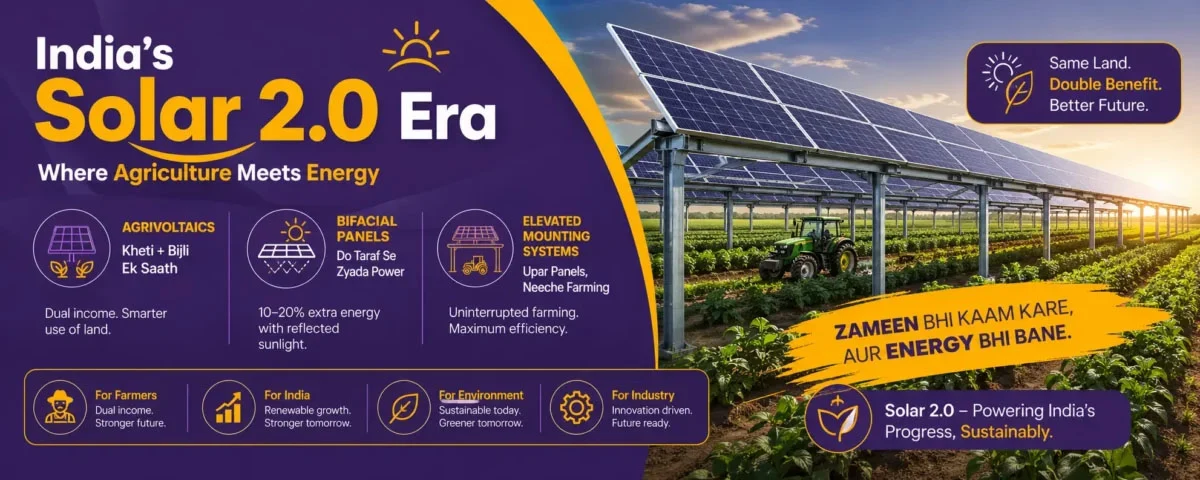
India Is Quietly Rewriting the Rules of Solar Energy — And Farmers Are at the Heart of It
For decades, India's solar story was simple: install panels, generate power, feed the grid. But something far more ambitious is now unfolding across the country's agricultural heartland. A new generation of solar technology — combining elevated mounting structures, bifacial panels, and a land-sharing approach called agrivoltaics — is turning India's farmlands into dual-purpose powerhouses.
Welcome to India's Solar 2.0 era: where the same plot of land grows both wheat and watts.
What Is Agrivoltaics, and Why Is India Betting on It?
Agrivoltaics (also called agri-PV or agri-solar) is the practice of co-locating solar panels and agricultural crops on the same land. Instead of choosing between a solar farm and a food farm, farmers get both — simultaneously.
The concept isn't entirely new. India has experimented with agrivoltaic pilot projects for over a decade. But scalability was always the stumbling block. Early systems were rigid, low to the ground, and incompatible with farming machinery. That's now changing fast — thanks to three converging technologies: elevated mounting systems, bifacial solar panels, and precision agricultural integration.
In August 2024, the Krishi Vigyan Kendra (KVK) in Ujwa, Delhi, unveiled a landmark agrivoltaic facility featuring solar panels elevated at 3.5 meters with 7.5-meter row spacing — specifically engineered to allow tractors and harvesters to pass freely underneath while still generating significant solar energy above.
It's a small facility. But it signals something enormous.
Bifacial Panels: The Game-Changer Behind the Numbers
One of the most significant technological shifts powering India's Solar 2.0 movement is the rapid adoption of bifacial solar panels — modules that capture sunlight from both their front and back surfaces.
Traditional monofacial panels only absorb direct sunlight from above. Bifacial designs go further by harvesting reflected light from soil, crop canopies, and surrounding surfaces — a natural advantage in agricultural settings.
Research shows that east-west vertical bifacial panels deliver roughly 5% greater land productivity compared to north-south fixed-tilt monofacial systems, especially at lower panel densities. In agrivoltaic configurations, where the reflective surfaces of crops amplify rear-side gain, this efficiency edge becomes even more pronounced.
The economics are compelling too. Global bifacial module prices dropped from USD 0.18 per watt in 2024 to USD 0.15 per watt in early 2026 — a 15% decline that disproportionately benefits elevated agrivoltaic structures where bifacial gain is highest. In India, bifacial modules are priced between ₹16–22 per watt, with manufacturers like LONGi Solar and Vikram Solar leading domestic supply.
Elevated Mounting Systems: Making the Impossible Possible
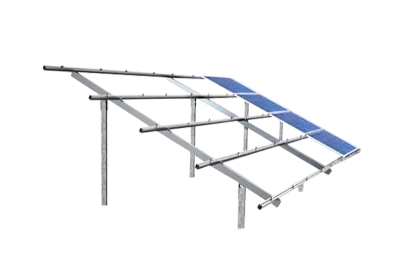
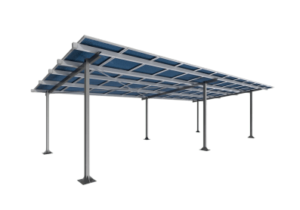
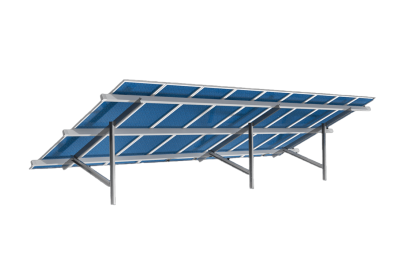
The engineering breakthrough that made large-scale agrivoltaics viable isn't the panel itself — it's the elevated mounting structure beneath it.
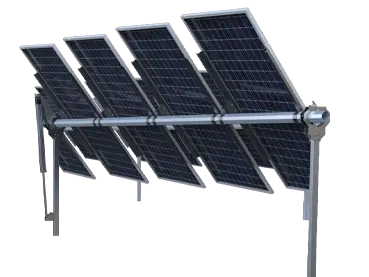
Older solar installations sat too low for agriculture to coexist comfortably. New elevated racking systems solve this by raising panels high enough for sunlight to filter through at angles beneficial to shade-tolerant crops, while simultaneously clearing enough headroom for mechanical farming to continue below.
This dual-use design is driving rapid market growth. India's 500 GW renewable energy capacity target by 2030 is widening demand for agrivoltaic-ready ground mounts across arid and semi-arid farmland. Globally, bifacial panels now account for over 75% of solar module production, and mounting systems are being redesigned from the ground up to optimize rear-surface albedo and minimize shading losses in these elevated configurations.
Dynamic tracking systems — which tilt panels in real-time to follow the sun — are growing even faster, recording a 29.44% CAGR globally as orchard and vineyard operators adopt precision light management for high-value crops.
What's in It for India's Farmers?
The financial case for farmers is arguably the most powerful driver of India's Solar 2.0 expansion.
Diversified income streams are the headline benefit. By leasing land to solar developers or co-owning systems under schemes like PM-KUSUM (which reimburses 30% of capital costs for feeder-level solarization), farmers earn steady rental income on top of their agricultural revenue — without giving up their fields.
The agronomic benefits are equally compelling:
- Water savings: Solar panels provide partial shade that reduces soil evaporation and crop water stress — a critical advantage for India's water-scarce states like Rajasthan, Gujarat, and Maharashtra.
- Crop protection: Panels act as a physical shield against unseasonal hail, extreme heat, and heavy rain — reducing crop loss without chemical inputs.
- Improved yield for shade-tolerant crops: Leafy greens, turmeric, ginger, and certain pulses actually thrive under partial shade. Scientific reviews suggest that agrivoltaic systems with a Ground Coverage Ratio of 25–35% maximize net benefits for these crops.
- Land Equivalent Ratio gains: Studies indicate that well-designed agrivoltaic systems achieve a Land Equivalent Ratio (LER) often greater than 1.5 — meaning the combined output of solar energy and crops from one plot exceeds what either use alone could achieve on separate plots.
In Maharashtra, a 50 MWp agrivoltaic system has demonstrated a competitive levelized cost of energy of just ₹2.02/kWh. On grape farms in particular, agrivoltaics can increase the economic value of land by over 15 times.
India's Market Momentum: Who's Moving and How Fast?
India's agrivoltaics market is no longer a niche experiment. It's becoming a mainstream investment thesis.
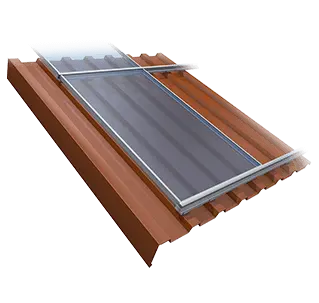
In December 2024, the National Institute of Solar Energy (NISE), GIZ India, and SunSeed APV signed an agreement under the DeveloPPP initiative to deploy a 16.5 kW rooftop agrivoltaic system at NISE's Gurugram campus — with an explicit mandate to identify optimal crops and test commercial feasibility for urban agrivoltaic farming.
That same month, the Indian government mandated that all clean energy projects must use locally manufactured solar cells and modules starting June 2026 — a policy shift that strengthens domestic manufacturing under the Production Linked Incentive (PLI) scheme and favors Indian bifacial module makers like Adani Solar and Waaree Energies.
Speaking of Waaree: in January 2025, the company announced the acquisition of Enel Green Power India for approximately USD 95.5 million — a clear signal that India's largest solar manufacturers are aggressively consolidating to capture the dual-use agri-solar opportunity.
Globally, the agrivoltaics market was valued at USD 6.3 billion in 2024 and is forecast to grow at a CAGR of 5.6% through 2034. India's share of that market is climbing rapidly, driven by its unique combination of vast agricultural land, high solar irradiance, and farmer-first government policy.
The Road Ahead: Challenges and the Future Outlook
India's Solar 2.0 story is exciting — but not without friction.
High upfront costs remain the most-cited barrier to mass adoption. Elevated mounting systems cost more than conventional ground mounts. Bifacial panels carry a price premium. And the technical complexity of integrating precision agriculture with solar infrastructure demands skills that most rural installers currently lack.
Regulatory clarity is another gap. Unlike Germany, France, or Japan — which have codified agrivoltaic standards, feed-in tariff premiums, and mandatory agronomic impact audits — India's policy framework is still catching up. Without clear definitions of what qualifies as a legitimate agrivoltaic project (versus a solar project that merely sits over farmland), capital allocation risks becoming speculative.
But the trajectory is unmistakably upward. Research interest in Indian agrivoltaics peaked at 870 publications in 2024 — a reflection of the growing academic and institutional confidence in this technology's potential. Government pilot schemes, international partnerships, and falling bifacial module prices are compressing the cost curve year on year.
As climate stress intensifies — droughts, erratic monsoons, and heatwaves become more frequent across India's agricultural belt — agrivoltaics offers something increasingly rare: a solution that helps both the energy crisis and the agricultural resilience challenge at the same time.
From Solarizing India to Transforming It
India's Solar 2.0 era isn't just about adding gigawatts to the grid. It's about fundamentally rethinking how the country uses its most precious resource — land.
By stacking solar energy generation above active farmland through agrivoltaics, bifacial panels, and intelligently designed elevated mounting systems, India is opening a path toward energy security that doesn't come at the cost of food security. That's not a trade-off — it's a breakthrough.
For farmers, it means new income without displacement. For the energy sector, it means new capacity without new land. For India as a whole, it means a credible shot at its 500 GW renewable target — while keeping 1.4 billion people fed.
The panels are going up. The crops are still growing. And India's most important energy story is just getting started.
India Solar 2.0 era, agrivoltaics India, bifacial solar panels India, elevated mounting systems, agri-solar India, PM-KUSUM scheme, dual-use solar farming, India renewable energy 2030, solar agrivoltaic market India, bifacial agrivoltaic systems, India 500 GW solar target, solar farming India, agri-PV India