


Rooftop Solar Mounting Systems India 2026: RCC, Metal Sheet & Tiled Roof Racking Guide
01/05/2026
Solar Mounting Systems for UAE, Saudi Arabia & Oman: Desert Heat, Wind Load & Corrosion Resistance Guide
14/05/2026
Introduction: A Milestone That Changes Everything
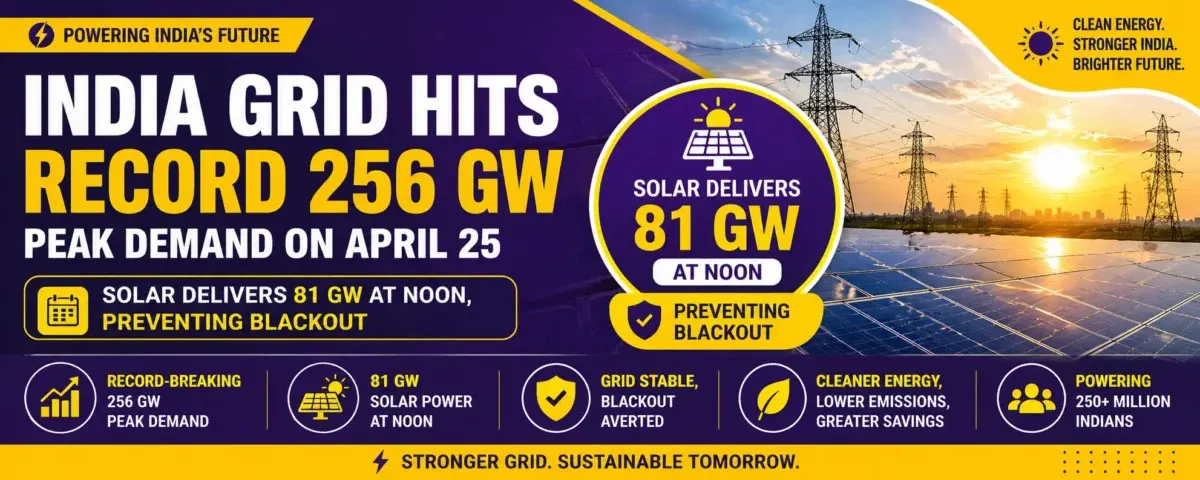
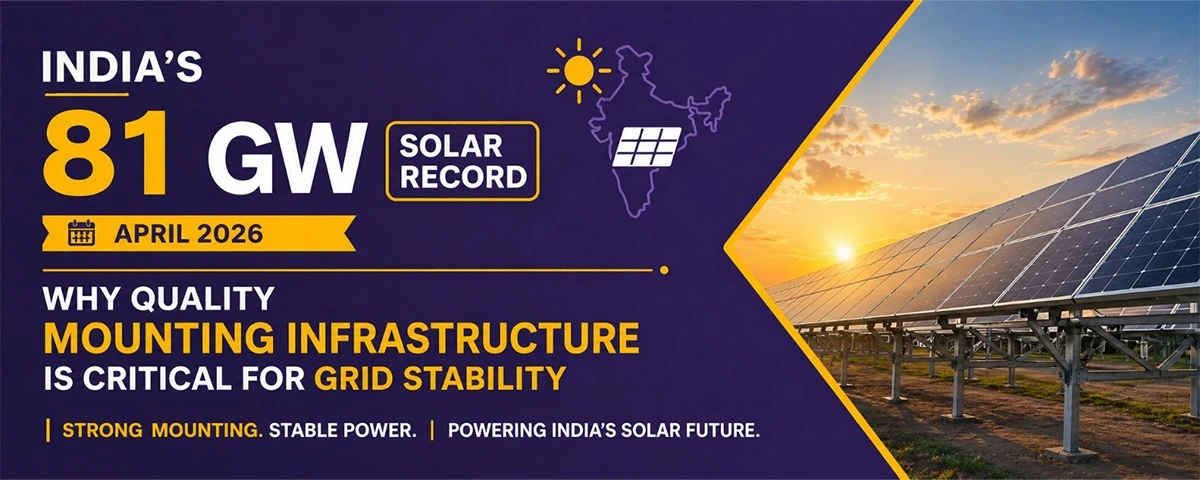
India made history in April 2026. For the first time, the country's installed solar capacity crossed the 81 GW mark — a milestone that puts India firmly among the top three solar nations in the world, alongside China and the United States. The announcement drew applause from policymakers, clean energy advocates, and investors globally.
But beyond the headline number lies a harder conversation — one that industry insiders have been having for years: Can India's physical infrastructure keep up with its ambitions?
As gigawatts pile up rapidly, the focus is shifting from how much capacity we can install to how reliably we can run it. At the center of that question sits something unglamorous but utterly critical: solar mounting systems.
What Drove the 81 GW Surge?
India's solar trajectory didn't happen by accident. A confluence of policy incentives, falling module prices, and aggressive state-level targets accelerated deployment across rooftops, open fields, and industrial zones.
The Production Linked Incentive (PLI) scheme for solar manufacturing gave domestic players a crucial edge. Meanwhile, the government's push for dual-use solar infrastructure — solar carports over parking lots, agrivoltaic installations across farmland, and floating solar over reservoirs — unlocked land that was previously off-limits for large-scale deployment.
International capital followed. Foreign direct investment in India's renewable sector crossed record highs through 2025, with major developers locking in multi-GW pipeline projects across Rajasthan, Gujarat, and Andhra Pradesh. By April 2026, the numbers had compounded into something truly historic.
The Infrastructure Problem Nobody Talks About
Here's the uncomfortable truth: not all of those 81 GW are performing equally.
Field surveys and developer feedback across major solar parks have consistently revealed a pattern — underperforming plants often trace their losses back to mounting and racking failures, not panel degradation. Corrosion from saline coastal air in Tamil Nadu. Wind-load failures in Rajasthan's dust storms. Misaligned tilt angles reducing yield by 8–15% annually. Foundation settlements that shift entire rows of panels off their optimal azimuth.
These aren't rare edge cases. They're industry-wide challenges that poor-quality PV racking solutions have quietly made worse.
When a mounting structure fails, it doesn't just affect one panel — it triggers a cascade. Electrical mismatches reduce string-level output, inverters throttle back, and grid offtake agreements go unmet. For project developers operating on thin margins with debt-financed assets, that's not an inconvenience — it's a financial crisis.
Why Solar Mounting Systems Are a Grid Stability Issue
This is where the conversation scales from project finance to national energy security.
India's grid operators are managing an increasingly complex balancing act. With 81 GW of solar now feeding into the grid — and more arriving daily — predictability and reliability of generation matter enormously. Solar is inherently intermittent, but within its generation windows, operators need plants to perform as modeled.
When solar mounting systems are poorly designed or rapidly manufactured to cut costs, the output variability introduced at the plant level ripples upward. Grid operators then rely more heavily on thermal backup or expensive ancillary services to maintain frequency stability. That's a hidden cost — borne by the public, not the developers who cut corners on racking.
Conversely, high-quality mounting infrastructure with precision-engineered tilt optimization, robust wind and snow load ratings, and corrosion-resistant galvanized or aluminum framing delivers consistent, predictable output. That consistency is what grid stability is actually built on.
Solar Carport Mounting Systems: The Dual-Use Revolution
One of the most significant trends accelerating alongside India's capacity additions is the rise of solar carport mounting systems and broader dual-use solar infrastructure.
Urban India is running out of easy land. Industrial rooftops are saturated. Open-field sites increasingly face community resistance and regulatory delays. Solar carports — structures that shade vehicle parking areas while hosting PV panels above — solve multiple problems simultaneously.
They monetize underutilized land, reduce heat island effects in urban zones, and generate power close to load centers, cutting transmission losses. For commercial and industrial (C&I) businesses, they offer an opportunity to meet corporate sustainability targets without sacrificing operational space.
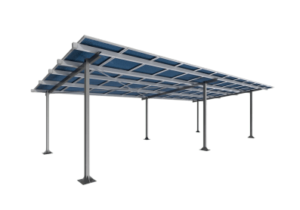
But solar carport structures face far greater structural demands than ground-mounted systems. They must accommodate vehicle movement below, support human loads during maintenance, and often meet municipal building codes that standard solar racking wasn't designed for. Only purpose-engineered carport mounting solutions — with appropriate span designs, load-tested components, and certified structural calculations — are fit for this application.
As India's dual-use solar pipeline grows toward an estimated 12 GW over the next five years, the quality bar for mounting infrastructure must rise in parallel.
Market Trends Shaping PV Racking Solutions in 2026
The solar mounting and racking industry in India has matured considerably, but it's also at an inflection point.
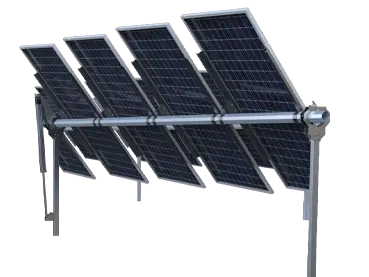
Tracker adoption is climbing. Single-axis trackers — which rotate panels to follow the sun throughout the day — can boost energy yield by 15–25% compared to fixed-tilt systems. As module costs fall, the relative value of trackers increases. This is driving demand for more sophisticated PV racking solutions that integrate mechanical tracking with smart controls and predictive maintenance capabilities.
Bifacial-ready designs are becoming standard. Bifacial panels capture reflected light from the ground beneath them, but only if mounting systems provide adequate ground clearance and avoid shading the rear surface. Racking manufacturers that haven't updated their designs for bifacial compatibility are quickly losing market share.
Material localization is accelerating. Under Approved List of Models and Manufacturers (ALMM) and Basic Customs Duty pressures, developers are increasingly sourcing mounting components from Indian manufacturers. The quality gap between domestic and imported racking has narrowed significantly — but due diligence remains essential.
What Developers and Businesses Must Prioritize
For solar developers, EPC contractors, and industrial businesses investing in behind-the-meter solar, the strategic lesson is clear: mounting infrastructure is not a commodity line item.
The right approach involves:
- Structural certification for the specific wind and seismic zone of the project site
- Corrosion protection standards appropriate for coastal, arid, or high-humidity environments
- Compatibility verification with the specific panel format, weight, and frameless configurations being used
- Long-term warranty terms that match the 25-year project horizon — not a 5-year product guarantee
- Third-party engineering sign-off for carport and elevated structures subject to public safety codes
Cutting costs at the racking stage is one of the most expensive decisions a developer can make — not because the upfront savings are small, but because the downstream consequences are so large.
The Road Ahead: 500 GW by 2030 and the Infrastructure Imperative
India's 81 GW achievement in April 2026 is a landmark, not a destination. The national target of 500 GW of renewable energy by 2030 — with solar comprising the lion's share — means the pace of installation needs to roughly double from here.
That scale demands a fundamental shift in how the industry thinks about mounting infrastructure. At 81 GW, individual project failures are painful but manageable. At 300 or 400 GW, systemic failures in mounting quality would become a national grid reliability problem.
The developers, financiers, and technology providers who recognize this now — and build quality solar mounting systems, robust PV racking solutions, and well-engineered dual-use solar infrastructure into their standard specifications — will be the ones who build projects that actually perform across their full asset lives.
India's solar story is being written right now. The foundation it runs on matters.
Conclusion: Building Gigawatts That Last
India crossing the 81 GW solar milestone in April 2026 is a moment worth celebrating. But the solar industry's job isn't just to install capacity — it's to install capacity that delivers on its promises for 25 years, in every weather condition, across every season.
That starts in the ground. It starts with the racking. It starts with the mounting.
As India races toward its clean energy future, quality solar mounting systems aren't a technical nicety — they're the silent backbone of every gigawatt that actually counts.